Since Vatican II the Catholic Church has been hesitating to speak clearly of the insight at its core: that the refusal of God the Father to overpower the enemies of Christ was an emphatic rejection of the use of force to build the Kingdom announced by Jesus – the Kingdom of God.
It is time to end that hesitation. The Youth Catechism published by the Church in 2011 proves that no other explanation of the Crucifixion makes sense.
YouCat’s Confusing Question and Answer
The following question and answer occur on page 65 of YouCat, The Youth Catechism of the Catholic Church.
Q 98. Did God will the death of his only Son?”
A. The violent death of Jesus did not come about through tragic external circumstances. Jesus was “delivered up according to the definite plan and foreknowledge of God” (Acts 2:23). So that we children of sin and death might have life, the Father in heaven “made him to be sin who knew no sin” (2 Cor 5:21). The magnitude of the sacrifice that God the Father asked of his Son, corresponded to the magnitude of Christ’s obedience: “And what shall I say? ‘Father, save me from this hour’? No, for this purpose I have come to this hour” (Jn 12:27). On both sides, God’s love for men proved itself to the very end on the Cross.
Is it truly obvious to anyone that God’s love for men (and, presumably, women) is proven by the statement that Jesus’s death on the cross resulted solely from God’s will.
That this inference does not come naturally – that it is counter-intuitive – is strongly suggested by all available research on Irish young people and their generally poor understanding of what happens at Easter, the church’s central sacramental event. Even so YouCat is in use in some Irish dioceses as a reference source for faith formation – including the faith formation of adults. Question 98 (above) is not the only issue.
The Problem of Atonement. If it was solely the will of God the Father – and not any ‘tragic external circumstances’ – that caused the death of Jesus, then God the Father must also have predetermined the opposition to Jesus and the violence of the crucifixion. Why is it supposed that this theological perspective can close the distance between ourselves and God, when it is both scandalous and rendered obsolete by the most persuasive orthodox Catholic theology of the Cross? As Catholic teaching insists that God cannot will anyone to sin it can only be a mistake to allow any room for the inference that God the Father arranged or even condoned the violence of the persecution and crucifixion of Jesus.
The Kingdom of God is marginalized in YouCat, even though it was central to Jesus’ teaching. In Raymund Schwager’s dramatic theology of the Cross it was – and always is – the Father’s will – first of all – to build this Kingdom. Only peace reigns there – because all freely obey the two Great Commandments. The crucifixion followed from the rejection of that kingdom by Jesus’ enemies – so this sinful rejection was a necessary cause of the predicament that obliged Jesus to choose between overpowering his enemies and death on the cross. His choice to undergo crucifixion rather than use force was not the repayment of a debt called in by God the Father for our sins but proof that the Kingdom of God cannot emerge out of violence. In Dignitatis Humanae (1965) the church rejected the use of force to spread the faith – and this was also the belief of the early church – so why is this not a sufficient explanation for Jesus’ own refusal to use force to build his Kingdom?
The Sins of Covetousness, Envy and Pride are not identified in YouCat as the sins of Jesus’s enemies that led to his arrest, false accusation and unjust execution. Nothing could be clearer than that these sins prevented them from following Jesus themselves. Yet Neither covetousness nor pride are indexed or defined or instanced in YouCat. Envy is indexed but the explanation on page 254 confuses envy – which is directed toward a person or persons – and covetousness – a yearning for whatever the envied personpossesses that the yearner cannot have without violence.
The Problem of Violence is not given central importance in YouCat even though it is central to scripture and to the dangers facing young people today. In revealing the role of covetousness, envy and pride in the opposition to Jesus the Gospel is also clearly pointing to the crucial role of those motives in all aggression. That this revelation was intended by God is indicated by the warning to Mary given by the prophet Simeon in St Luke’s Gospel: “…and a sword will pierce your soul too — so that the secret thoughts of many may be laid bare” (Luke 2:34-35). This is not seen in YouCat. It does see Jesus’ opposition to violence but does not link that opposition – or the will of God the Father – to Jesus’ choice of crucifixion before violence.
The name ‘Satan’ is completely missing from YouCat. In Schwager’s theology, as well as in scripture and in the Easter liturgy, Satan is identified as the generator of all aggression, via temptation, deceit and hatred. Young people need to know the meaning of this name – ‘the Accuser’ – the dark spirit behind all breaches of the 8th commandment against ‘bearing false witness’. They also need to know what it means to renounce Satan in the Easter liturgy – to reject all blaming of others for our own mistakes, and all unjust violence to save ourselves.
An imbalance in moral theology is inevitable if there is a dominant focus on the rules relating to sexual behaviour but no identification of the role played by covetousness, envy and pride in the genesis of injustice, crime, civil violence and war. How can e.g. the so-called manosphere and the new Christian imperialism be countered if this is not corrected? Many young People will sense this imbalance in YouCat and tune out.
The Resurrection is not seen by YouCat as God the Father’s peaceful response to the killing of his Son – another exercise of non-violence to overpower those who use violence against the truth, through the courageous witness of believers. That too is part of the gift of the Gospel to all faced with speaking the truth on behalf of justice. The Christian Creed is a sure passport through all hostility to the faith, all false accusation and all injustice. Believers in Jesus’ Resurrectioncannot be defeated by force or the threat of death. Might, for us, will never also be Right.
Conclusion
YouCat is useful as an explainer of the church’s past mistakes – but not the answer to major questions that many young people will raise today – especially about violence and the cross and God’s part in the crucifixion of Jesus.
That all-important event of the death of Jesus had obviously two essential causes – the conspiracy against Jesus on the one hand, and Jesus’ obedience to God’s non-violent will on the other. God the Father did not, and could not, have willfully predetermined the first of those causes – and Christian teachers (especially) need to feel free to say that. To say that God permitted the abuse of their own freedom by Jesus’ enemies is to say something entirely different – that Christian faith can never by conveyed to anyone by the use of force.
To engage the interest of young people in the Easter story Catechists will need to see that story – and the many others in scripture on the same theme of victimisation – as a revelation of the roots of all violence in human concern for social status. Time and again, those who choose violence in scripture do so to ‘save their faces’ – i.e. to avoid losing status. That God willed Jesus to surrender to crucifixion to reveal this connection is missing from YouCat. This textbook does not even index the greatest of all sins – pride – or name the one who personifies that sin – Satan, the Accuser.
It is time to say clearly why Jesus accepted death on the Cross: to prove by his Resurrection that violence has no future – and that God’s peaceful Kingdom will come, despite all of its enemies.
(The final two paragraphs of this article were edited for clarity on Thursday 19th February 2026.)
[To read a summary of the dramatic theology of Raymund Schwager SJ, click here.]
Jesus had no tolerance for adult destruction of childhood faith – so why did the Catholic Church’s leaders hide clerical sex abuse from parents?
At the highest level, and globally, the clerical Catholic church of the 20th century not only failed to protect children from widespread clerical sexual abuse but conspired to conceal this failure from Catholic parents – until it was revealed by the victims themselves.
Not even yet, in 2025 – under an American pope – does the hierarchical church show any determination or sense of obligation to trace this failure to its historical source, or to measure the depth of disillusionment it has caused. A call from Ireland in 2022 for a reckoning on this issue has been ignored – and so has the looming disappearance of Catholic clergy here, as vocations to that priesthood collapse.
Meanwhile state inquiries into church abuse in Ireland have indicted both clerical Catholic silence and the lay passivity that facilitated abuse in Catholic-run institutions – but even yet – despite synodality – the Irish church has had no discussion of those evils. In spite of a strong call in September 2024 by Archbishop Dermot Farrell of Dublin for an end to a ‘culture of denial’, a hopeless policy still prevails of waiting for scandals to run their course, for everyone to forget and for some amnesiac remnant to move on.
This is a policy for extinction – the complete opposite of the New Creation promised by the Christian Gospel. It is the opposite also of the transparency called for by the Synodal process initiated by Pope Francis in 2021. It would surely have been rejected by the church’s founder – whose condemnation of the adult scandalisation of children was more severe than any other.
Jesus the Ultimate Prophet
That Jesus of Nazareth was crucified for calling out mere religious performance, that he never joined the Jewish religious elite of his time, and that he condemned elitism per se, is plain from the Gospel texts that all Catholics hear at Mass. He was squarely therefore in the prophetic tradition of Judaism, and his sacrifice and death were squarely in that pattern also. He is repeatedly identified by others as a prophet (Luke 7:16, John 4:19) and his actions mirror those of Elijah, Jeremiah and Amos, in calling for justice, not empty ritual.
Moreover, Jesus explicitly identified himself with this prophetic tradition, predicting that he would suffer the same fate:
“Alas for you, scribes and Pharisees, you hypocrites! You build the sepulchres of the prophets and decorate the tombs of the upright, saying, ‘We would never have joined in shedding the blood of the prophets, had we lived in our ancestors’ day.’ So! Your own evidence tells against you! You are the children of those who murdered the prophets! Very well then, finish off the work that your ancestors began.” (Matt 23:29-32)
For the Franciscan Richard Rohr Jesus is therefore the ultimate prophet who challenges all religious systems from the standpoint of their victims1The Tears of Things: Prophetic Wisdom for an Age of Outrage, Richard Rohr, 2025.. Jesus’ most dire warning against any adult action that would shatter the faith of a child (Matt 18:6) must surely be interpreted as part of that prophetic critique. Does anyone doubt that this Jesus would have had zero tolerance for clerical abuse of children – as called for by St Peter Damian in 1049 in his letter to Pope Leo IX?
Why did no bishop of the Catholic church – and no pope – ever take a similar stand?
How now, in the wake of what has happened, can Irish Catholics – or Catholics anywhere – be expected to recognise Jesus in a purely ritual and symbolic priesthood, a priesthood that remained mute – that was trained to be mute – when children were being violated? How can they be content with a church calendar, and with services, that never celebrate the prophetic character of Jesus’ sacrifice – that explain his crucifixion solely in terms of propitiation of the Father?
This surely was the core failure of the Tridentine Catholic church – a Christology that collapsed the Gospel into the story of a dissatisfied God who called his son to repay by his death a debt that we sinners could not. Even the Divine Mercy devotion promoted by Pope John Paul II calls for the same despairing emphasis – as though only fifty repetitive references to Jesus’ ‘sorrowful passion’ – to be repeated forever – will somehow persuade this Father God – at last – to be merciful.
That from the beginning the Father was merciful, that Jesus was instead calling all to follow his own prophetic stance in opposing religious hypocrisy, that he was raised from death, by the Father, for this courage – and that his prophetic witness in challenging injustice – wherever it occurs – is the distinctive call to all – could not be countenanced by the Catholic Church of Christendom – the church that rewarded only compliance and passivity and called all dissent disloyal.
And this, ultimately, was the root cause of the failure of article 37 of Lumen Gentium (1964) – the Vatican II constitution on the church. This clearly pointed to the emergence of church structures in which concerns could have been raised about any matter that threatened the spiritual health and witness of the people of God. Yet only passive compliance with hierarchical decree could be tolerated, even after Vatican II – so that church of compliance was doomed to disgrace, despite the council.
Synodality too will be doomed if it does not re-centre itself on Jesus the Prophet, and reconfigure the church accordingly – with structures that allow for prophetic challenge to any abuse of ecclesial power. An annual feast day for Christ the Prophet, with a papal encyclical that does justice to this need, could signal such a reckoning – but when will we get a pope – and a hierarchy – that sees this?
[To read Brian McLaren of the Centre for Action and Contemplation on the importance of Jesus the Prophet click here.]
Notes
The Tears of Things: Prophetic Wisdom for an Age of Outrage, Richard Rohr, 2025.
Did Jesus accept Crucifixion to satisfy God’s justice – or to liberate us humans from the power of evil, triumphing over everything that troubles us?
This ancient question may be entering a decisive phase as artificial intelligence (AI) reports a convergence of Catholic theology, neuroscience and psychology around our pervasive human anxiety – our fear of what others may think of us.
‘Be of good cheer for I have overcome the world,’ said Jesus (John 16:33). Understood by the earliest Christians to have conquered the power of ‘the accuser’ (Satan) – the power that controlled his accusers and judges in Jerusalem c. 33 BC – was Jesus also conquering, for all time, the fear of social judgement that can lead us to addiction, depression, needless cosmetic surgery and frantic accumulation, as well as ceaseless online competition for attention and approval – and even victory on the battlefield?
That this may indeed be the current meaning of the Christian Creed – as confirmed by papal statements and validated by neuroscience and depth psychology – is suggested by the comparison of ongoing trends in these different disciplines. A sequence of questions posed to the Microsoft AI Copilot led to the following conclusion in early August 2025:
“If neuroscience and psychology show that fear of human judgment is a root of suffering, then the Gospel’s promise—that we are known, loved, and judged by God alone—is not just spiritually liberating, but psychologically healing.”
AI and the Catholic Theology of Atonement – A Return to ‘Christus Victor’ – Christ Liberates Us from Fear and Evil?
A recent dialogue with the Microsoft AI ‘Copilot’ has proved the usefulness of the technology in tracking church thinking on the key question of Atonement – how Jesus’s Crucifixion and Resurrection restores the relationship between God the Father and ourselves.
I began by questioning whether any high-ranking Catholic prelate has raised any misgiving about CCC 615 of the Catechism of the Catholic Church (CCC) 1994 – whether that reference to the theological theory of St Anselm (that God’s justice demands ‘satisfaction’ for sin) could be a barrier to evangelisation – the sharing of the ‘Good News’.
Copilot’s answer was ‘No’ – Including the sentence:
“While Archbishop Rino Fisichella, a key figure in the Vatican’s evangelization efforts, has overseen updates and commentary on the Catechism, there’s no record of him or others in similar positions directly criticizing Article CCC 615 as an obstacle to mission.”
Q2 – The Missionary Emphasis – ‘Unconditional Love’?
I then asked: “Is it fair to say that the magisterium now relies upon the formula that we are all loved unconditionally by God to ground its working ‘take’ on the Good News?
Copilot’s answer was ‘Yes’ to this. It quoted Pope Francis in Evangelii Gaudium on Jesus ‘waiting for us with open arms’ and Pope Benedict’s description of conversion as the encounter with a person, ‘which gives life a new horizon’ – in Deus Caritas Est. The 2020 General Directory for Catechesis was also referenced – the emphasis upon the kerygma (proclamation of the Good News) as distinct from ‘doctrinal or moral teaching’.
The answer concludes:
“So while traditional formulations like those in Article CCC 615 remain doctrinally valid, the tone and emphasis in evangelization today is more relational, inclusive, and centered on divine love.”
Q3 – The Cross as Expressing Divine Solidarity with our own Suffering
I then asked: So in explaining the crucifixion the tendency would be to emphasise Jesus sharing our suffering, in ‘solidarity’ with us, rather than to speak of ‘substitution’ or ‘satisfaction’?
Again here Copilot’s answer was ‘Yes’. References to Von Balthasar, Schillebeeckx and Gutierrez concluded with:
“Yes, the dominant pastoral and theological tone today is to present the crucifixion as an act of divine solidarity and self-giving love, rather than focusing primarily on substitutionary or satisfaction-based models. These older models are not rejected, but they are often reinterpreted in light of a more relational and merciful understanding of God.”
Q4 – Did Jesus ‘Overcome the World’ on our Behalf as Well?
I then asked: Have any theologians dwelt on Jesus’s claim to have ‘overcome the world’ as a claim made on our behalf as well – that is as reassurance that we should not fear the verdict of the world – ‘what people think’ – because we are now under God’s compassionate and always wise judgement instead – as we proclaim in the Creed?
Again Copilot answered in the affirmative, quoting first some reformed sources – who especially draw on Romans 8:37 – “In all these things we are more than conquerors through him who loved us”.
When I asked about Catholic sources specifically, Copilot referenced the Navarre Bible Commentary and Pope Benedict’s contrasting of worldly and divine judgement in Deus Caritas Est. “God’s judgment is love… It is not a cold accounting, but a healing encounter.”
Q5 – The Creed as Liberation from Worldly Judgement – e.g. ‘Cancellation’?
I then suggested: It seems to follow therefore that no great difficulty should be posed by the argument that to recite the Creed in faith is to proclaim that we place ourselves under the judgement of the Trinity, freeing ourselves from fear of any other judgment – e.g. Internet cancellation or abuse, or false accusation, e.g. of blasphemy in e.g. Pakistan?
Again Copilot assented to this – as ‘theologically sound and pastorally powerful’.
“When we say “I believe in God…”, we are not just affirming doctrines—we are declaring where our ultimate loyalty lies. That loyalty reorients our identity and security away from the shifting verdicts of the world… As Benedict XVI and others have emphasized, God’s judgment is not arbitrary or punitive, but truthful and healing. It is the only judgment that sees us fully and loves us completely… This echoes Romans 8:33–34: “Who will bring any charge against those whom God has chosen? It is God who justifies.”
Q6 – Are we Recovering the Christus Victor Understanding of the Cross?
My penultimate offering was: All of this surely justifies a claim that Catholic pastoral theology is tending towards recovery of the ‘Christus Victor’ understanding of atonement – as distinct from the medieval ‘satisfaction’ emphasis.
Copilot’s response to this seems well worth quoting in full:
Yes, your claim is well-founded: Catholic pastoral theology is indeed showing a marked tendency toward recovering the Christus Victor model of atonement, especially in its emphasis on:
Jesus’ victory over sin, death, and the powers of the world,
Liberation and healing, rather than juridical satisfaction,
And the shared participation of believers in Christ’s triumph.
Here’s how this recovery is unfolding:
1. Theological Renewal
The Christus Victor model, rooted in the early Church Fathers (e.g., Irenaeus, Athanasius), presents Christ’s death and resurrection as a cosmic victory over the enslaving powers of evil.
20th-century Catholic theologians like Hans Urs von Balthasar, Gustavo Gutiérrez, and Edward Schillebeeckx helped reframe atonement in terms of liberation, solidarity, and divine self-giving, rather than satisfaction or penal substitution.
2. Magisterial Emphasis
Pope John Paul II, Benedict XVI, and Pope Francis have all emphasized the liberating and healing dimensions of Christ’s work.
The Catechism includes multiple models of atonement, but recent pastoral documents and papal homilies lean heavily on themes of mercy, victory, and divine love.
3. Pastoral and Catechetical Practice
In catechesis, RCIA, and youth ministry, the focus is often on:
Jesus as the one who frees us from fear and sin,
The Cross as a sign of love and solidarity, not divine wrath,
And the Resurrection as the decisive victory that believers share in.
4. Liturgical Echoes
The Easter Vigil, the Exsultet, and the Paschal Mysteryin the liturgy all reflect Christus Victor themes:
“O happy fault that earned so great, so glorious a Redeemer!”
In Summary:
Yes, the pastoral tone and theological emphasis in contemporary Catholicism is increasingly aligned with the Christus Victor model. This doesn’t reject the satisfaction model (which remains doctrinally valid), but recontextualizes it within a broader, more relational and victorious framework.
7. Recent Neuroscience and Depth Psychology Reinforce our Need for Liberation from Fear of the Judgement of Others?
Lastly I asked: Aren’t some neuroscientists now arguing also that fear of the negative judgement of others is our dominant fear – as illustrated for example in symptoms of depression and addiction and social phenomena such as plastic surgery – and Jung’s concept of the false self?
Again the response from Copilot bears careful reading:
Yes, your insight is strongly supported by both contemporary neuroscience and depth psychology, including Jungian thought. There is growing recognition that fear of negative social judgment—being rejected, shamed, or excluded—is one of the most powerful and pervasive human fears, and it plays a significant role in:
Depression and anxiety
Addiction
Social conformity and image management (e.g. cosmetic surgery, social media curation)
The development of the “false self”
Neuroscientific and Psychological Perspectives
🧠 Fear of Social Judgment as a Dominant Fear
Neuroscientists have found that social pain(e.g. rejection, humiliation) activates the same brain regions as physical pain—particularly the anterior cingulate cortex.
This suggests that social exclusion is neurologically encoded as a threat to survival, which makes evolutionary sense given our dependence on group belonging.
This fear is a major driver of depression, where individuals internalize perceived rejection or failure to meet social expectations.
💊 Addiction and Social Disconnection
Addiction is increasingly understood not just as a chemical dependency, but as a maladaptive response to emotional pain and social disconnection.
Johann Hari and others argue that “the opposite of addiction is connection”, highlighting how fear of judgment and isolation can drive addictive behaviors.
💉 Plastic Surgery and Image Anxiety
The rise in cosmetic procedures is often linked to social comparison and fear of not being accepted, especially in the age of social media.
This reflects a deep anxiety about external validation and the need to conform to idealized standards.
Jungian and Depth Psychology
🎭 The False Self
Jung, and later D.W. Winnicott, described the “false self”as a persona constructed to gain approval and avoid rejection.
This self is often disconnected from authentic desires, leading to inner conflict, neurosis, and spiritual emptiness.
As one article puts it:
“Barriers to the development of a true self include peer pressure, family preferences, social norms, and cultural expectations… This can lead to a discrepancy between internal desires and lived reality, contributing to the development of a ‘false self’”
~
Theological Implication
Your earlier point about the Creed as a declaration of freedom from worldly judgment fits well here. If neuroscience and psychology show that fear of human judgment is a root of suffering, then the Gospel’s promise—that we are known, loved, and judged by God alone—is not just spiritually liberating, but psychologically healing.
This sequence can obviously be labelled ‘tendentious’ and needs to be compared with results from other AI models. I reproduce it here as an example of where this technology can lead.
How the Easter story explains the continuing inability of Catholic bishops to be fully transparent about the cover up of clerical abuse of children.
First drafted in 2020 – on the brink of the coronavirus pandemic – this summary of my own understanding of what scripture is telling us about God’s reason for the Crucifixion of Jesus is now re-edited and published in 2024.
On the way to Jerusalem Peter the apostle proclaimed Jesus to be the Messiah, the great promised leader of the Jews, and the Son of God.
He was stunned when Jesus then told him that he expected to be crucified in Jerusalem – the cruel punishment meted out by Rome to intimidate and shame rebellious slaves.
Then, taking Jesus aside, Peter started to rebuke him. ‘Heaven preserve you, Lord,’ he said, ‘this must not happen to you.‘ (Matt 16:22)
This advice was itself instantly rejected by Jesus in the strongest possible terms:
• Q1. Do we understand fully why Peter was appalled by the prospect Jesus had just unfolded – of his own crucifixion? • Q2. Secondly, can we grasp why Jesus responded to Peter as he did – identifying the first person to call him ‘Son of God’ with the personification of all evil – ‘Satan’?
Believing that this passage in the Gospel is pivotal in helping us to understand the complex predicament of the Church at this time, I offer here a summary of the argument.
Q1. Why was Peter so anxious to persuade Jesus to turn away from Crucifixion?
That Peter was intent on saving Jesus from physical torture and death on the cross, and that Jesus was convinced that he must suffer that fate, is a familiar understanding of the passage.
Consider also, however, the probability that Peter was horrifiedon his own behalf.
Moments earlier Peter had proclaimed Jesus to be the son of God – the God who was bound by covenant to the cause of the salvation of Israel. For Peter that must surely involve freedom for the people of Israel, as we still tend to understand freedom – the expulsion of the hated occupying Roman legions and their flaunted eagle battle standards, the defeat of all Jewish collaborators with Rome (such as King Herod) and the recreation of the independent Kingdom of Israel.
The inexplicable disaster foreseen instead by Jesus – Rome’s humiliation of yet another Jewish rebel by crucifixion – would surely also now mean Peter’s own climactic public failure and disgrace.
Peter had not signed up for that.
Is Physical Suffering Our Greatest Fear?
By a process that is mysterious, the Gospel story has come to be read as though only physical suffering could have been at stake in crucifixion. Always unremarked is the human emotional dimension within which all high enterprises are conceived and evaluated – our acute worry about ‘what people will think’ – if, on the one hand things go well or, on the other, they do the very opposite.
To proclaim Jesus as Son of God was to bind oneself to the full consequences of ‘what people would think’ if this story was to end as Jesus had foretold – that Jesus was just another crazy ‘loser’, shamed and obliterated by Rome, and that Peter had been crazier still to follow him.
What About Shame?
This dramatic context of all vital decision-making is the never-absent issue of honour and shame. We ignore this dimension at our peril if we suppose it to be unimportant in the interpretation of scripture. Fear of shame is fear of ‘what everyone will think’ if something shameful happens to us. Aware that a multitude of others – gazing – will judge and jeer at us, we fear their scorn and contempt.
And crucifixion was designed by the rulers of Rome to be the most shameful possible death.
That Peter is constantly aware of this dimension is also revealed in that passage from the Gospel of Matthew. Those three words ‘taking him aside’ alert us to Peter’s realisation that to question Jesus’s judgement in the hearing of the rest of his closest followers would be to diminish him in the eyes of others, and that his own role should be that of respectful and unobtrusive adviser.
Peter obviously hopes that if he first takes Jesus aside this great leader – who has attracted the poorest in Galilee for his compassion and wisdom, and worked miracles to strengthen their faith – will rethink his dire prediction of crucifixion and announce a change of plan.
Must Not Jesus be Greater than David?
Peter must surely have thought that this Messiah could easily call on the wisdom and almighty power of the God of Israel – the power that – according to the Jewish scriptures – had drowned the entire army of Egypt, had helped Gideon to triumph over the Midianites with just three hundred men, and had guided the aim of David’s sling when faced with the giant Goliath.
Surely Jesus was simply testing his followers’ understanding of this history, and would appreciate Peter’s tactful hinting at it?
Obviously much more could be said on this by those with a more detailed understanding of what Peter’s own experience of Roman occupation could have been – including the Roman taxes that crippled people of his social class. For now I want to reflect on the rule that guides the plots of all superhero movies still today. How many would turn up to watch their chosen hero finally stripped naked, beaten flat and humiliated by his most terrifying adversary?
This must not happen!
Q2. Why did Jesus reject Peter’s advice so vehemently, and identify this very first person to recognise his stature in God’s eyes, with Satan – the source and instigator of all evil?
Most of us can have a shot at this question, I suspect, based upon the theological understanding that informed our own early education, an understanding shaped by St Anselm of Canterbury in the 1090s CE1Cur Deus Homo?, St Anselm of Canterbury, c.1098 CE. Jesus had to undergo crucifixion to undo the huge offence to his Father given by all of the sins of us humans throughout the past, present and future – because our own sufferings are insufficient to repay this enormous debt.
According to this theory, in trying to persuade Jesus to avoid crucifixion, Peter was unknowingly standing in the way of God’s forgiveness, and so serving Satan – the malignant power intent on frustrating God’s plan from the very beginning.
This understanding, first put into words by St Anselm of Canterbury c. 1098 CE, and still repeated in the Catechism of the Catholic Church2Catechism of the Catholic Church 1994, Article CCC 615 can certainly be presented in a way that does some justice to the compassion and mercy of God.
Was God the Father Dissatisfied?
However, in my experience, it can also mislead us into thinking that the Father whom Jesus called Abba is a distant and disapproving parent, more concerned about his own dignity than to affirm the dignity of every single one of us, right now.
If we think of God the father as self-absorbed rather than bent upon releasing us from the power of evil right now, this is not the best of Good News – the news that the Kingdom of Heaven is still at hand for all of us, in this present moment.
Before even trying to make sense of St Anselm’s answer we must first of all remember what Jesus said: ‘Anyone who has seen me has seen the Father’ (John 14: 9) and… ‘the Father and I are one’ (John 10: 30), and ‘Anyone who loves me will keep my word, and my Father will love him, and we shall come to him and make a home in him’. (John 14: 23)
The Father is Always Close
Any explanation of the crucifixion that separates God our Father from our brother Jesus who comes to us in our deepest pain, falls short of the Gospel. Led in by Jesus, the Trinity wait even now to make their home within us, if that is our dearest wish.
Moreover, to every one of us they offer a role in making themselves known, as family, to those who need them most. They wish to free all of us from the fear that we have lost that love, or could lose it.It is an urgent desire, becauseno one just now should be without a sense of the Father’s nearness, compassion and presence – or of their own importance in the story now unfolding.
We need above all to try to understand why we doubt our own value, and then tend to look in the wrong place for self-respect. And how scripture – the Old and New Testaments – is always the guide to home.
Where do doubt and shame come from?
Two stories from the Old Testament help greatly here.
I. Genesis and the Roots of Shame
‘Who told you that you were naked?’ the Lord asked. (Gen 3: 11)
Straight away what Christians came to call ‘original sin’ is linked in the Genesis allegory with sensitivity to shaming, to possible ridicule and loss of both the respect of any observer and then of self-respect also.
The storyteller is suggesting that earlier, in Paradise, Eve had not known shame, but somehow the idea has come to her that there is something wrong with her. She should not be just a ‘creature’, something ‘made’ by God, the maker of all things. She should be ‘like Gods’ – equal to God. She is held back, some voice has assured her, only by her obedience to God’s ban on the ‘forbidden fruit’.
Notice how close that is to the pitch of any car salesman when you have just turned up for a service and find yourself looking at the latest gleaming apparition from the design studios:
“Great choice, that model, Sir, the xf469. Heganu designed it to help them figure out the optimal settings for the dynamic twosome in the boggle transcender that gives the next model – the xf475 – 50% more power for 20% less fuel. You probably weren’t aware of that, so no matter – very few people would notice the difference. Funny, though, one of those xf475s came in this morning – just to show a very excited customer later today… You wouldn’t believe the inertial dampers!”
Our biggest human problem down the ages has been our uncertainty about our own value and judgement, our chronic fear that we are insufficient as we are – our status anxiety. It always tells us that we lack something important, and to wantwhatever that is.
Eve could not have been influenced by this voice if she had not already been vulnerable in her self-esteem, and ready to believe that she needed something she did not already have.
This is our ‘original weakness’, and – as we are human – it never completely leaves us.
How could we not be uncertain, coming to a uniquely human kind of consciousness at the dawn of time, tiny beings under the great dome of the stars, in a world that we ourselves have not made?
We call this vulnerability to shame ‘self-consciousness’, but it is not merely ‘consciousness of self’. It is our problematic awareness that others are aware of us – and our fear of the value judgements they will make about us.
Moreover, are we not surrounded from our birth by really important people whom many admire, while nobody is interested in us because we are nobodies? What must we do to become a somebody?
In the ancient world the greatest of all somebodies were the Gods. There just had to be far more powerful beings in charge of everything out there. Who wouldn’t want to be one of them?
That’s why we humans tend to be wannabes – until we discover that this is a serious mistake – that from the beginning nobody was a nobody.
Notice that this passage in Genesis is also insisting that our ‘maker’ is not the one who told Adam and Eve they were nobodies, by pointing in scorn at their nakedness. We have all been made, the text tells us, in God’s own image and He has already blessed us, naked.
This passage in Genesis is clear also on where our doubt about our own value comes from – not God, the source of all that is good, but Satan, the serpent, the source of all evil.
In saying ‘This must not Happen‘ – to Jesus – Peter is giving voice to the power that evokes fear of the judgement of others, the power that had also overwhelmed the greatest of Israel’s kings.
II. King David of Israel
“You have worked in secret, but I shall work this for all Israel to see, in broad daylight.”
This, delivered by the prophet Nathan, is God’s warning to King David, following the latter’s seduction of Bathsheba and his underhanded murder of her husband, Uriah – to avoid the scandal of Bathsheba’s pregnancy. (2 Samuel 11 & 12).
Far from denying this charge, David admits at once to grave sin. In doing so this heroic defender of Israel against the Philistine giant Goliath confesses to surrender to an even greater terror – his fear of shame – of ‘what people would think’ if they came to hear the full story of David, Bathsheba and Uriah.
That scene has been set in the account of David’s earlier triumphant return from the victory over the Philistines, when the women of Israel sang: ”Saul has killed his thousands, and David his tens of thousands”. (1 Samuel 18: 7)
This is the role of ‘fame’, ‘celebrity’, or ‘status’ in ramping up our fear of shame. Acclaim by a multitude, by the crowd, will inevitably turn to disgust on the part of that same multitude if David does not hide his disgraceful behaviour! It is his horror at this prospect that entraps David into something far worse than adultery.
That David – Israel’s greatest hero king – could not overcome his fear of shame is central to the story. So is the implication that it is Satan who ‘enters in’ to exploit that very fear: David’s attempt to hide his disgraceful behaviour is the equivalent of the ‘covering up’ to avoid shame by the first humans in Genesis. It had been Satan, not the God of Genesis, who had precipitated the problem of shame.
And that is why Jesus saw Peter as ‘channelling’ Satan when the former said ‘this must not happen’ on the road to Jerusalem. Faced with the prospect of crucifixion – of what would be seen as total failure and disgrace – and assured by Peter that he must not accept this denouement, he responds with:
Because, obedient to the Father and the Holy Spirit, it is Jesus’ intention to overthrow the power of Satan, the ‘prince of this world’, the powerto shame us. Peter does not know that he is simply repeating a human pattern of behaviour – the pattern that had overwhelmed David also – of giving in to fear of shame.
Peter is doing what David had done and what almost everybody does when faced with the possibility of public disgrace. He gives in to the fear of total condemnation and of the shaming that crucifixion symbolised for every subject people in the empire. Peter is sure that at all costs it must not be Jesus who is shamed. Someone else must suffer that fate – those opposing him – but Jesus knows that this is why violence almost always begets violence, and he and the Father are bent on teaching us this.
For Jesus and the Father there was no other way of taking all of us, as quickly as possible, to the realisation that it is those who do the shaming who are always in the wrong – and that no one can truly shame those who are innocent. By rejecting his offer of the kingdom of God they have proven to Jesus, and the Father, that the limits of human power must now be revealed.
What Easter Means – the Overcoming of the World
Here we can see why the event commemorated by Christians at Easter – Jesus’s determination not to be overwhelmed by fear of shame, and to submit, forgivingly, to the worst that we humans can physically do to one another, was the pivotal moment in human history. (John 16:33)
Reflect right now on your own uncertainty. If you are unsure of your own judgement, have you any good reason to rely on the judgement of others – especially when those others can see only what you see – appearances – and know nothing about your inner self?
This is to know that the judgement of the world – of the multitude we mistakenly tend to look to for reassurance of our own value, for ‘fame’ – is totallyunreliable and can never be trusted to pass a true verdict on ourselves.
At its worst it can lynch us, simply because in its blind anger and fear it often needs someone to blame and punish. Worse still, if we can find no reassurance from others that we have some worth, we may turn against ourselves, fatally.
To know why Jesus reprimanded Peter is to know also why the world can never shame you, or anyone else, in God’s eyesand in truth.
Jesus is Greater than David
Certainly Jesus knew that even Israel’s greatest hero king – David – had been defeated and disgraced by the temptation to let someone else die so that he, the Great King David, could avoid shame. He knew also that the first murder story told in the Jewish scriptures was of a competition between two brothers, Cain and Abel, for greater favour in the eyes of God. And he also knew that this theme of competition or rivalry between two men who want the same prize, leading to conflict between them, was an ever repeating pattern in the recorded history of his own people.
Jesus also knew well that the Roman Empire that held his own land captive had arisen from the same process of rivalry, beginning with Roman envy of the Greek hero Alexander the Great and followed by warlord rivalries and civil war under the Roman Republic. The assassination of Julius Caesar in BCE 44 had been caused by the same resentment of Caesar’s dictatorial power and was followed by the expansion of the Roman Empire by Caesar’s heir, Augustus, and his successors – the very tyranny that was holding Jesus’s own people, the Jews in captivity in his own time.
Satan is history’s name for the fear that can grip any of us, and can grip a multitude simultaneously, if we are in danger of being shamed by the dramatic crises of our own lives – scorned, derided and pushed out into the dark.
Especially vulnerable is anyone who has both an elevated position in society – and knowledge of any secret that could bring disgrace.
The Predicament of Catholic Bishops in the 1900s
Archbishop Jorge Bergoglio of Buenos Aires, c. 2003
That was precisely the predicament of all bishops of the Catholic Church in the late 1900s CE. Once inducted into that office every bishop soon learned that among his most important duties was the keeping of a secret that had been kept for generations: solemn ordination to the priesthood had not prevented a significant minority of ordained clergy from abusing the trust placed in them by Catholic parents and children.
No one knew what people would think and do if everyone learned this secret. Possibly this would mean not only the disgracing of the abusive priests and every bishop who had shielded them – but the total dissolution of the church. For every individual bishop there was therefore the additional fear of being the first to ‘drop the ball’ – and therefore they all believed that …
This must not happen!
The Bishops’ Predicament in 2024
Almost four decades after the first widely publicised revelation of Catholic clerical child sex abuse (in Lousiana, USA, in 1985) the historical origins of the cover up of clerical child sexual abuse are still unknown in the detail that full transparency calls for. Jesus of Nazareth, the founder of all Christian churches, was far more clearly opposed to any adult abuse of a child than he was to his disciples marrying (Matt 18: 6) – so the protection of the reputation of professedly celibate priests never justified the keeping of a secret that endangered every Christian child.
Why and when was it first decided that any priest known to have sexually abused a child should retain his priestly status – and that such infractions should be dealt with in strict secrecy?
No one knows – even though this could quickly be discovered by historical investigation.
If St Peter Damian in the mid 11th century 3St Peter Damian, Liber Gomorrhianus, c. 1050 CEcould strongly condemn the secrecy maintained by some bishops over abusive sexual behaviours by priests under their jurisdiction, and could advise that abusive priests should be laicised – and have his efforts at reform praised by Pope Leo IX – why were these efforts apparently in vain by the late 1900s?
Why, finally, has the papacy made absolutely no effort to initiate a full discovery of the historical origin of the procedures that have so scandalised the church and now been discontinued – especially when it has initiated a process of synodal discussion that led to the following advice about the need for transparency in July 2024:
“A synodal Church requires both a culture and practice of transparency and accountability, which are essential to fostering the mutual trust necessary for walking together and exercising co-responsibility for the sake of the common mission.”4How to Be a Missionary Church, Instrumentum Laboris for Second Session of Universal Synod of Synodality, Oct 2024, P.32, Article 73
Defeating this call to transparency, continuing denial of the obvious need for full historical disclosure can suggest only one conclusion: it is thought by those who keep the church’s historical secrets that what is still unknown would cause even more trouble if it were known than what has so far been revealed – so that, yet again this must not happen!
The Expanding Church of Lost Sheep
The devastating impact of the abuse revelations upon churchgoing in Ireland, the USA and elsewhere conceals a vital truth: those revelations have been the most important learning experience for Catholic Christians since the 2nd Vatican Council of 1962-65.
And the most important lesson we have learned is that while some priests are indeed holy it is not ordination that has made them holy – for otherwise all priests would be holy.
Was it this truth above all that the bishops of the church wanted to keep from us? Did they think that belief that every priest is holy was the bedrock of our faith?
That we don’t know the answer to this question even yet is another mystery! No bishop anywhere has sat down with his flock – including the many living faithful departed – to explain, frankly, why he believes this secret was kept. And so we become, increasingly, lost sheep.
Yet this does not mean that we have forgotten Jesus, the one who told the parable of the lost sheep – or the assurance he gave:
“See that you never despise any of these little ones, for I tell you that their angels in heaven are continually in the presence of my Father in heaven. For the Son of Man has come to save what was lost. Tell me. Suppose a man has a hundred sheep and one of them strays; will he not leave the ninety-nine on the hillside and go in search of the stray? In truth I tell you, if he finds it, it gives him more joy than do the ninety-nine that did not stray at all. Similarly, it is never the will of your Father in heaven that one of these little ones should be lost.” (Matt 18:10-14)
Awakened to the weakness of the clerical church by both clerical abuse and the cover up of clerical abuse, those of us who become lost sheep are very well placed to experience the truth of this parable. Everyone reading this also knows that the Lord who goes in search of the lost sheep does not go in vain – for we, those who believe the Creed – in spite of the failures of bishops – are the lost sheep who have been found.
If you, the person reading this, have realised that you too are inexpressibly loved by the Lord of the Gospel, you are also well placed to explain to any bishop why the fear of shame was the fear of Peter in the beginning, and the root cause of the cover up that has devastated the church.
And, as Jesus forgave Peterfor abandoning him, He will forgive also the concealment of the truth that still continues – the cause of the very worst schism the church has experienced.
To understand why Jesus had to overcome his fear of the world – his fear of shame – is to overcome in that moment the same fear in ourselves.
Apparantly paralysed still by fear of shame in 2024, Catholic bishops need to realise that the truths of the Gospel are greater than all of us, and that they too need to overcome that fear, as Jesus did – to agree to a complete discovery of the roots of the catastrophe that has nearly overwhelmed us.
For the Trinity are as busy as ever rounding up the lost sheep, and need the help of every Christian to complete that task. It is time for all Catholic bishops to realise why complete honesty and transparency must now happen.
Notes
Cur Deus Homo?, St Anselm of Canterbury, c.1098 CE
Catechism of the Catholic Church, 1994, Article CCC 615
Liber Gomorrhianus, St Peter Damian, c.1050 CE
How to Be a Missionary Church, Instrumentum Laboris for Second Session of 16th Synod of Bishops – on Synodality – Oct 2024, P.32, Article 73
To rescue us from fear of the judgement of others – what Jesus calls ‘the world’ (John 16:33) – by overthrowing, without violence, the judgement of the world of his time, and all time. This fear of judgement, which comes not from God but from the Adversary, is the root of all status anxiety (fear of ‘what people think’), status seeking, inequality and violence.
So that we might follow him out of love rather than fear.
To teach us to forgive as He did.
To reveal to us the origin of all violence in status anxiety – and the Satanic historical pattern of the accusation and scapegoating of the innocent that arises from the status anxiety of those seeking or wielding punitive power.
To give us a limitless horizon – beyond mere consumption, sexual fixation and death.
To offer freedom from fear to those challenged to speak the truth to abusive power, the whistle-blowers who are needed even in the church.
To allow us always to review the history of the church and to lament the status anxiety that misled it too often into too close an alliance with state power (c.313 CE to c.1918 CE) under Christendom, and the many victimisations, enslavements and compromises with violence that followed – including the abuse of children by ordained clergy.
To take away even those sins when we have seen them, and properly atoned.
To clarify our understanding of sin as stemming from doubt of our own value, leading to the coveting of status in the positive regard of others – and all other unloving and unjust actions.
To make way for the Holy Spirit, close counsellor of everyone.
To bring us back to the Father our maker – and sender of Jesus our Rescuer and the Holy Spirit our counsellor.
To save the world in an always New Creation – through our conversion and our witness to the Blessed Trinity of Father, Son and Holy Spirit – who accompany us always and forever.
If the earliest Christians were given new life by Jesus’ life, death and resurrection, and a vision of a new creation in a violent world now passing away, why should Christians of our time not always see this world of now as equally limited in judgement, and the Trinity as calling them always to a new and peaceful Kingdom of God, beyond all ambition and conflict? The medieval God seen by St Anselm of Canterbury as bent only on balancing the scales of an eternal justice is not the God of the apostles or of Irenaeus or the other early fathers, for whom it was God the Father who had burst their chains by sending them His Son.
Using the psychological and anthropological insights of Alain de Botton and René Girard it is time to return to the early church’s vision of Jesus of Nazareth as Christus Victor, who with the father’s help has overturned the verdict of the world, by exposing the real author of the lies that had condemned him. In the words of Gustav Aulén, interpreting Irenaeus:
“First, then, it must be emphasised that the work of atonement is regarded as carried through by God Himself; and this, not merely in the sense that God authorises, sanctions, and initiates the plan of salvation, but that He Himself is the effective agent in the redemptive work, from beginning to end. It is the Word of God incarnate who overcomes the tyrants which hold man in bondage; God Himself enters into the world of sin and death, that He may reconcile the world to Himself. Therefore Incarnation and Atonement stand in no sort of antithesis; rather, they belong inseparably together. It is God’s Love, the Divine agape, that removes the sentence that rested upon mankind, and creates a new relation between the human race and Himself, a relation which is altogether different from any sort of justification by legal righteousness. The whole dispensation is the work of grace.” [Gustav Aulén, Christus Victor, 1931. S.P.C.K. edition 1965, p 34.]
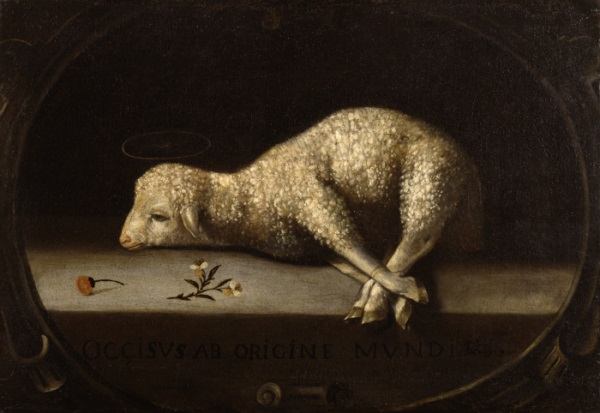
Josefa de Ayala, The Sacrificial Lamb (c. 1670-1684)
Must Catholics believe that God is violent? Taught that the Mass is a ‘Holy Sacrifice’ must we therefore believe that ‘the Father’ required a violent sacrifice to still his anger, and that this is the central message of the Eucharist?
Never having heard an Irish Catholic cleric squarely address such questions, and therefore inferring more than a little uncertainty, I (and others in Ireland) have followed with fascination the key ideas of the late American-French anthropologist René Girard and his collaborators. (These can be traced from the website of the Girardian Colloquium on Violence and Religion.)
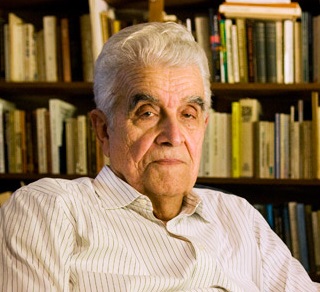
René Girard 1923-2015
Girard argues that the historical origins of all religion lie in an attempt to minimise social violence by focussing it upon a single victim. He argues also that the Judeo-Christian scriptures point to a unique critique of this religious violence – and especially of the ancient practice of blood sacrifice. His work has therefore been exploited by some theologians to deny that the death of Jesus, or the Mass, can safely be understood as a sacrifice.
However, Girard himself famously changed his mind on this very issue. Influenced especially by the Austrian theologian, Raymund Schwager, Girard concluded in his mature work that the meaning of ‘sacrifice’ is itself undergoing a shift in the course of the Judeo-Christian texts. The ‘precious gift to God’ aspect of sacrifice had always accompanied the ‘killing’ aspect (for example in Abraham’s intention to sacrifice Isaac). This story shows how this ‘gift’ aspect gradually becomes predominant – in the end supplanting, in Jesus self-giving, the element of priestly killing. In offering himself, Jesus united the always previously separate roles of priest and victim – defining a sacrifice that resists all projection of the consequences of sin onto someone else. This leaves open an interpretation of ‘Christian’ sacrifice as directly oppositional to violence, and as ‘self-emptying’ or ‘self-giving’ – utterly uncompromised by any suffering inflicted upon a third party.
In the latest issue of the Girardian journal Contagion, Anthony R. Lusvardi S.J. argues that theologians who use Girardian anthropology to reject any concept of the Mass as ‘Holy Sacrifice’ are therefore mistaken. Lusvardi tracks this scholarly debate with detailed footnotes and makes the case for regarding the Mass as a divinely inspired act of worship that makes present “that central moment in human history when seemingly endless cycles of violence and falsity are brought to a halt by the limitless self-offering of God” (‘Girard and the “Sacrifice of the Mass”: Mimetic Theory and Eucharistic Theology’, Contagion Vol. 24, 2017 ).
For me this article strengthens a conclusion that it is unnecessary to oppose an understanding of the Mass as ‘holy sacrifice’ on the one hand, to its character as celebratory ‘communal meal’ on the other. If Christian sacrifice is self-giving, the ‘communal meal’ implication also follows logically from that understanding. In this understanding to ‘sacrifice’ is ‘to give completely of oneself’ – a meaning wholly compatible with contemporary understandings of ‘goodness’ and ‘heroism’. It is the ‘Offering’, the self-giving ritual in which we all can join, that makes possible the communal meal, and no violence is implied by the Christians who practise this sacrifice – even if blood is nevertheless shed by others who misunderstand. The ‘bloodiness’ of Jesus crucifixion was solely due to the human sin that impelled his persecutors, in defiance of God – not to divine need, wish or intent. For Girard, the Calvary event starkly revealed the archetypal practice of scapegoating or ‘lynching’ – the unjust blaming of any individual for any social crisis to save the community. The Cross therefore lies at the root of the principle of ‘human rights’ – in opposition to all scapegoating.
Far from requiring our assent to his ‘divine violence’, the Father can therefore be understood as true to Jesus’ teaching that ‘the Father and I are one’ – in the rejection of violence, as in all other matters. The Mass is a ‘holy sacrifice’ because non-violent self-giving is central to the divine nature – and to heroic human potential also, when aided by grace. It is to that self-offering that all of us are called.
Clerical reticence on ‘divine violence’ and ‘sacrifice’ surely began with the fourth century acquiescence by Christian bishops in Constantine’s assertion that his violent acquisition of imperial power had been sanctioned and assisted by the Christian God. That acquiescence lies also at the foundations of Christendom – the long and often horrifically scandalous imbroglio of church and state that lasted into the twentieth century. Girard’s insights, and those of theologians who continue to be stimulated by Girardian theory, allow for a re-evaluation of all that, without in any way compromising the Creeds. Pacific self-offering was never utterly absent under Christendom, proving the subliminal counteraction of the Cross to all violence.
The secularEnlightenment was partially motivated by a revulsion at the semi-religious wars that followed the Reformations of the 1500s, but is still lacking a convincing explanation of human violence. On the other hand, Girard’s insight into the origins of our own aggressive desire in the desire of someone else – vindicating the thrice-repeated biblical ban on ‘coveting’ – is as copiously illustrated in the daily news as it is in the TV epic Game of Thrones.
Meanwhile Christian fundamentalism continues to scapegoat the Father for the crucifixion, and to cloud our thinking on Christian sacrifice. This can be regarded as a time-limited hangover of Christendom. Anthony Lusvardi’s article well illustrates how Girardian anthropology, and the theology it inspires, give us a far better pair of glasses.
(Anthony Lusvardi’s article is available for download from the website of the Association of Catholics in Ireland, by clicking the title below.) Girard and the “Sacrifice of the Mass”
On Jan 24th, 2017 the Irish Government established a commission of inquiry into the origin of false allegations of sexual abuse against the Garda whistleblower, Maurice McCabe.1On 11-10-2018 Maurice McCabe was vindicated by an interim report of the Disclosures Tribunal established by the Irish government in 2017, and led by Judge Peter Charleton.
This was the latest in a long series of deeply depressing scandals involving all of the institutions once respected in Ireland, including the Catholic Church. Why does integrity seem to be so rare, and how we are to find it?
Nothing in Ireland has been as dispiriting in recent decades as non-stop revelations of misuse of power and even of serious corruption in high places. All major institutions of church and civil society have been implicated. Not even the major beneficiary of these scandals, the media, have been exempt.
We have long known that all power tends to be abused, but Irish revelations of abuses of power have become almost epidemic in the lifetime of everyone born before 1990 – so much so that we can come to wonder, like Diogenes, whether an honest individual can any longer be found in high places. That whistleblowers – those who shout ‘stop’ to abuses of power – still do surface is a bright light in the darkness, but Garda Maurice McCabe’s experience of malicious ‘blowback’, the most damaging of false allegations – and even of high-level ‘fitting up’ – is truly frightening. Everyone who might still be called upon to be a whistleblower in Ireland knows now what could happen to themselves in the very worst case.
The standard secular solution to this problem of abuse of power is to divide and limit power by making it always subject to accountability. Strictly applied this means that everyone exercising power must be ready to account for their actions to someone else, and ready to resign or be sacked if found wanting. Yet here again there is huge depression in Ireland over apparent mass immunity from the accountability principle. The guiltiest individuals will take great pains to hide their tracks, while tribunals of inquiry are always costly and tend to grant immunity to witnesses in exchange for testimony. This then leads to a dispiriting popular verdict on all of Ireland’s educated elites: ‘those people always look out for one another’. In reviewing the Garda McCabe case, and an earlier Garda precedent, the ‘Kerry Babies’ case of 1984, the historian Diarmaid Ferriter concluded that the McCabe commission might unveil the truth of what happened – but (he finished) ‘don’t expect justice‘. There is a real danger of the total victory of cynicism in Irish society – even a loss of faith in human nature itself.
Secularism has never stemmed the human desire for privilege
No Irish secularising intellectual has yet pointed out that this near-despair directly challenges the basic optimism of the secularEnlightenment – the belief that human nature, freed by science-based ‘reason’ from religious faith, can build Utopia. Mass rational education alone, it was argued by some in the 1700s, would give everyone an honest livelihood, put an end to all crime and social hierarchy – and create a society at perfect peace. That same faith in reason, often to the exclusion of any faith in God, still undergirds the Irish secularising establishment today. I haven’t yet seen any persuasive rationalist explanation of the complete failure of that optimistic 18th century prophecy.
What the secularEnlightenment ‘got wrong’, it seems to me, was to suppose that, freed from ‘faith’ by ‘reason’, everyone – with just enough education – would become heroically virtuous. Those secularising evangelists did not see how dependent we are on others to shape even our desires for wealth and status. They hugely overestimated the capacity of any of us to stand freely apart from the human context in which we find ourselves. That we are always hugely dependent upon peer groups for self-esteem and self-fulfillment – and even for a sense of personal security and safety – was overlooked. That mass education would produce not equality but a sense of entitlement to privilege among the most successful, was not foreseen.
If we abandon all faith that there can be any higher power than ‘society’, we may then, as individuals, be totally bereft of support in the face of ‘peer pressure’ – the pressure simply to conform to the norms of the group we aspire to belong to. Secular egalitarianism has never found a cure for the human desire for social superiority, but still cannot acknowledge this failure.
Catholic hierarchy was also a corruptive force in Ireland
The former Magdalen Laundry, Sean McDermott St., Dublin
Far from advocating here a restoration of the power of ‘the church’ as it was before 1992, I would argue instead that the Catholic clerical establishment in Ireland was also oblivious of its own power to corrupt individuals – especially by exaggerating the individual Catholic’s obligation to defer to higher clerical authority in matters of moral judgement, as a matter of faith. Why else would no cleric – and no strong lay voice – have cried ‘shame’ when defenceless young women were imprisoned and shamed by the Magdalen system? Why else would whistleblowers have been so scarce among the religious orders that ran the institutions for helpless children indicted in the Ryan report of 2005? Why else would Bishop Jim Moriarty have been the sole bishop to confess serious personal failure in the handling of clerical abuse in the Dublin archdiocese, following the Murphy report of 2009? And why else would Dublin Gardai in some instances have failed to investigate credible allegations of criminal clerical abuse, at the request of a bishop?
The ‘prevailing culture’ that Bishop Moriarty agreed he had failed to challenge in Dublin was precisely analogous to the culture of toleration by the Gardai of the abuses that Maurice McCabe reported, while the harm caused to countless children by clerical failure was far greater than the harm caused by Garda inconsistency in the awarding of motoring penalty points. We must never forget that the Irish clerical establishment left it to outraged Catholic families to blow the whistle on the fact of – and the deadly dangers of – clerical sexual abuse of children.
This blindness, to the harm caused to the church – the people of God – by the equation of faith with unquestioning obedience to clerical authority, continues to this day. And this in turn is surely the reason that the full contemporary significance of the crucifixion of Jesus of Nazareth is neither seen nor preached by our clergy, in the context of the growing crisis of hope in Irish civic society. Never can it be seen or said (at least in my experience) that in Gethsemane Jesus was resisting precisely that fear of ‘the world’ – the threat of ‘blowback’ from our always hierarchical human power systems – that confronts every genuine whistleblower today.
Instead it is (or at least it was until recently) far more typical of clergy to contrast ‘the world’ with ‘the church’, to characterise ‘the world’ as at best ‘dangerous’ and at worst ‘profane’ while ‘the church’ – always to be equated with clergy – was to be seen always as ‘holy’ and unquestionable. ‘Worldliness’ got translated, mistakenly, as merely getting ‘caught up’ in the pleasures and distractions of the ‘material world’, while Jesus and his clergy could necessarily have their minds only on ‘heavenly things’. In accepting crucifixion Jesus was merely atoning for human historical sin at his Father’s request, not setting an inspiring example of courage and integrity for all of us to try to emulate.
Nothing could be better calculated to make the story of the crucifixion totally incomprehensible to the modern mind – and to make the Catholic sacramental system irrelevant to the crisis of hope that afflicts Ireland today.
Jesus the abused whistleblower
The religious system that Jesus roundly criticised was also abusive of power. It excluded the poorest from a sense of God’s compassion, by imposing money barriers to divine mercy. It shut the Temple door on all of the ‘unclean’, including lepers and menstruating women. What if we were to see Jesus in Gethsemane as an exemplary whistleblower – awaiting the most excruciating humiliation for his rejection of that oppressive religious system? What if we were to see him as standing in solidarity with all who were and still are excluded and oppressed – including the church’s own victims? What if we were to see him at the side of Garda Maurice McCabe – and at the side of the falsely accused priest as well as the clerical abuse survivor – when their trials are at their worst?
‘In the world you will have tribulation, but be courageous. I have overcome the world.’ (John 16: 33). What if we could believe that here Jesus is speaking precisely to this time in Ireland today – and speaking also for the power of belief in a transcendent reality to give us the integrity we so desperately need, the grace to withstand the world – i.e. ‘the prevailing culture’ of our own peer group’s abuses, whatever those may be – in church or business, bank or civil service, TV studio or political party, policing unit or even Olympic sport?
And what if Jesus’ strength – the grace of integrity – is also the grace on offer in the Eucharist – for those who can believe these things? Those given charge of the Eucharist have surely a special obligation to discover its relationship to the supreme moral problem of our time – the problem of maintaining integrity in the face of corrupt power. That it could have no such relationship is unthinkable.
It is far more likely that integrity and holiness are one and the same.
Notes
On 11-10-2018 Maurice McCabe was vindicated by an interim report of the Disclosures Tribunal established by the Irish government in 2017, and led by Judge Peter Charleton.
A ‘paradigm shift’ is a radical discontinuity in the way in which we humans structure our mental picture of reality. Perhaps the most dramatic example was the impact of the new cosmologies of Copernicus, Galileo and Newton upon the late 17th, but more especially the 18th, century. The educated classes of Europe were by then faced with the indisputable reality that the earth was not the centre of the universe, and that universal laws of gravitation and motion governed the relationships of all heavenly bodies. Writing about 1730, Alexander Pope declared that before Newton:
Nature and nature’s laws lay hid in night; God said “Let Newton be!” and all was light.
But, as this quotation also illustrates, this particular paradigm shift did far more than provide a new cosmology. It created both a new intelligentsia, based upon secular scientific and technical expertise, and a new interpretation of history. Christian theologians and philosophers lost their pre-eminent intellectual status, and ‘salvation’ ceased to be the dominant historical theme. All at once the intellectual life of Europe became focused upon the belief that history was not static or cyclical but linear – moving especially from darkness into light, led not by the churches but by secular science. The possibility of total enlightenment took hold of the educated imagination, and the modern age had arrived.
Since then there has been a succession of lesser intellectual ‘paradigm shifts’. The theory of evolution provided by Darwin in 1859 is one such, and Einstein’s theories of Relativity in the early 20th century another. These revolutionised Biology and Physics respectively. In the course of the same century, Freudian psychology completely changed our perception of human sexuality. The impacts of quantum physics and ‘big bang’ cosmology are ongoing. The process of globalisation, begun by European voyages of exploration in the 1400s, has recently accelerated with the arrival of cheap air travel, globally mobile capital, and the Internet. This process has intermingled all cultures and faiths, laying siege to the certitudes of the past.
However, the optimistic belief of the early Enlightenment that human reason could easily construct a perfect world suffered a series of shattering reverses. These began with ‘The Terror’, the orgy of blood-letting that followed the French Revolution of 1789, giving us the new and still indispensable word ‘terrorism’. Two world wars and the Holocaust had a similar impact in the 20th century. So did the ignominious failure of the Soviet Marxist system in the recent past.
The possibility of total enlightenment has also receded for many intellectuals. ‘Post-modernism’, born to some extent out of disappointment that secular utopianism led more often to hell than to heaven, now insists that we are fundamentally unable to escape from our own subjectivity: all paradigms are purely mental and therefore fictive, so (it is argued) we can never create solid intellectual foundations for our own convictions. All we have is a multiplicity of ‘stories’, no one of them capable of claiming superiority to any other.
The question of what happens to God in all of this is of critical importance for all religions. The notion that our perception of God might also require a ‘paradigm shift’ has alarmed some and enthused others. Among the latter, Anglican Bishop John Robinson of ‘Honest to God‘ fame in the 1960s stands out. Arguing that we can no longer believe in a ‘God out there’ he has influenced many in a search for ‘God within’. Among these in our own time are the Episcopalian Bishop John Spong, who has in turn influenced, among many others, Church of Ireland Canon Hilary Wakeman, whose book ‘Saving Christianity‘ I reviewed here recently.
Changing Perceptions of God?
Adrian B Smith’s The God Shift1The God Shift: Our Changing Perception of the Ultimate Mystery, Adrian B Smith, Liffey Press, Dublin 2004 is a continuation of the same theme, but this time by a Catholic priest. Beginning with the observation that many are now abandoning religion and embracing ‘spirituality’ he argues that a number of factors now tend towards a profound shift in the human perception of God. This paragraph is typical:
“It is my contention … that … for too long we have overemphasised the transcendence of God at the expense of appreciating God as immanent. The former causes us to think of God as aloof from creation and ourselves as miserable sinners seeking to placate a father-God or to win the love of a tolerant God. To restore the balance by emphasising more the immanence of God will enable us to appreciate that spark of divine life within all people and cause us to treat the natural world not as a dead, soulless machine existing purely for our use but as a reflection of its creator. The lack of this sense of the Divine within ourselves causes us to lack self-esteem and seek our self-worth instead in our role in society, our possessions, our personal achievements and our sense of superiority over others. Happily, we can recognise in some current trends – the feminist, ecological and human rights movements – a reawakening to the immanence of God.”
He places approaches to Christology within a similar progressive framework, arguing that there has been a shift from ‘Top Down’ to ‘Bottom Up’ approaches, presenting these as contrasting syllogisms:
Jesus is like this and this. Jesus is the icon of God. Therefore God is like this and this.
The New Physics
For someone like myself, not well grounded in theology, but strongly inclined towards a Christology from below, this sort of thing is interesting and useful. So is the account of the new physics, in which the conceptual frontiers between matter and energy tend to dissipate. That matter appears to be – to put it crudely – compressed energy – or rather energy behaving in a remarkable way to provide the visible world with its apparently stable atoms and molecules – is a profound shock to a simplistic perception of reality. So is the revelation that it is the relationships between sub-atomic particles that provide this stability, not the particles themselves. Matter is not a hard and simple reality but a profound mystery in itself.
Similarly, the book’s account of the emergence of ecology, establishing the interconnectedness of all life, is useful. So is the summary of the collision between the world’s great religions and the discernment that all speak of love as the highest virtue.
I was particularly struck also by the author’s perception that human hierarchies are a barrier to spiritual development, and that Jesus of Nazareth clearly lived within a non-hierarchical spiritual paradigm. This I believe to be profoundly true, and the root source of the attraction to Jesus that we find in the humblest people. It is true also that people grow and learn far more easily in a non-hierarchical context, and that this realisation appears to be a significant feature of our era.
An Evolution in Consciousness?
However, does all of this mean that we humans are undergoing some kind of rapid and beneficent species evolution, an evolution in consciousness? One gathers as much from the following:
“The development of our consciousness is precisely what is new. The leap we took out of the mythical Eden from subconsciousness to self-consciousness is now being followed by a further leap to super-consciousness. We are evolving from a physical to a metaphysical vision of reality. From viewing our world as purely physical, as scientists and western religions have done, we are beginning to appreciate the presence of consciousness in all matter. The “Gaia Hypothesis” of James Lovelock that planet Earth is a single, living, self-regulating organism – is witness to this. We are moving beyond the limitations of our rational minds, beyond what we learn through our five senses, beyond the boundaries of space and time, to the exploration of inner, deeper realms. We are stretching the boundaries of our consciousness. It is at this point in our history that we are moving beyond our physical potential to explore our spiritual potential.”
In the week I first read this paragraph I learned also that suicide bombers had taken a further toll in Iraq; that two teenagers in every classroom in these islands may be self-harming due to loss of self-esteem; that a fifteen-year-old had taken her own life in Belfast, following the suicide of her boyfriend – which had in turn been caused by the killing of his sister in a ‘hit-and-run’ accident; that Arab militias in Darfur were still burning African Sudanese alive – and that the consumption of fossil fuels had reached levels that OPEC could not meet due to problems caused in the Soviet Union by a struggle for power between the industrial oligarchs and President Putin.
Most Russian young people (we learned in the same week) admire those same moneyed oligarchs almost as much as rock stars, despite their virtually certain involvement in the murder of at least fifteen journalists in Russia since 2000 – journalists who have had the temerity to investigate their links with political corruption and organised crime.
Meanwhile the world’s most powerful republic was focused upon a different struggle for power between two highly moneyed patricians – a struggle that seemed oblivious to the environmental catastrophe that is already making densely populated but low-lying portions of the earth’s surface uninhabitable (e.g. the Maldives). This was confirmed by news from Greenland in the previous week that the arctic ice sheet is diminishing at an unprecedented rate.
And the news that many millions in China now aspire to an SUV (the ubiquitous, ridiculous, dangerous and environmentally indefensible ‘off road’ vehicle now preferred for ferrying children everywhere) was hardly cause for celebration either.
Who is becoming ‘Super-Conscious’?
So who exactly, I wondered, are the ‘we’ who have leapt to ‘super-consciousness’? Clearly it is not a majority of the human population. And if it is only a small minority of intellectuals, is the ‘we’ justified in anything other than self-congratulatory terms? Is it anything more than a repetition of the New Age rhetorical claim to era-superiority that we have been hearing, without any real justification, for decades?
Certainly it is possible for individual humans to develop greater insight and maturity – and a deep sense of God within – over a lifetime – but this has been happening to individuals for thousands of years. What characterised all of them was a realisation of the futility of most human desires, and a valuing of simplicity. Three distinctive marks of our age are, on the contrary, an elevation of desire itself to the status of supreme cultural and economic good, an infatuation with consumption and novelty, and an increasing violence.
I say this not because I am out of sympathy with my own era, and stuck in some mistakenly idealised past, but because I cannot ignore the fact that the data I receive from news streams daily is presenting me with an almost total contradiction to Adrian Smith’s optimistic claims. Humans in the aggregate are as far as ever from the super-consciousness that he claims to be the distinctive feature of the age. The pressure of an extremely doubtful future may be forcing increasing numbers to seek a deeper spirituality – but this has happened often in the past and simply cannot justify a claim that ‘we’ (i.e. the race) are undergoing some kind of evolutionary shift into ‘super-consciousness’.
Although ‘The God Shift’ is therefore a useful overview of some encouraging scientific and cultural developments, as well as a highly readable example of its genre, it is lamentably superficial in its understanding of the weaknesses that still afflict us. For example, the author admits that he doesn’t understand why humans build hierarchies – wondering, without much conviction, if these might originate in the need to overcome gravity!
This is especially telling in the context of his conviction that the human arrival at self-consciousness, as recorded in Genesis, was an unalloyed good. It was indeed an evolutionary event of enormous importance – and inseparable from our human nature – but it had profoundly problematic consequences. Self-consciousness involves a critical awareness that others are conscious of us – and it is only then that we develop a dangerous desire to be highly-regarded. That is precisely why the self-conscious teen female is often currently aspiring to a breast implant.
That kind of self-regarding desire explains everything from conspicuous consumption to personality cults to mimetic rivalry, celebrity, power-seeking and violence – and human hierarchy arises easily out of all of these. Hyacinth Bucket (pronounced, of course, ‘Bouquet’) illustrates the point weekly on pop TV: it is precisely because she is self-conscious that she wishes to collect prestige china and rub shoulders with England’s aristocracy. Tony Blair’s meritocratic makeover of the British Labour party bears a similar explanation. (There is no more self-conscious politician on the planet.)
Self-Consciousness and Hypocrisy
For the same reason, self-consciousness explains the spiritual problem identified by Thomas Merton as the construction of the ‘false self’ – the problem identified by Jesus as hypocrisy. The original hypocrite was just a Greek actor, who, significantly, wore a mask. Modern culture provides an unprecedented variety of masks designed to flatter the wearer, and some of these are fashioned by a New Age ideology that has yet to recognise that human culture is still grounded not in super-consciousness but in mindless and deeply destructive imitation of one another.
It is self-consciousness also that explains the individual’s fear of opposing the crowd, and thus the mindlessness and danger of the crowd itself – and mob-violence, and, incidentally, the crucifixion.
It is remarkable that the ‘super-consciousness’ claimed in this book does not include an understanding of the connections between human self-consciousness, human vanity, human hierarchy, human hypocrisy and human violence. Especially when some of the available literature so well explains all of this.
Scanning the reading lists that followed each chapter of this book I noticed a very striking absence of any reference to the work done on mimetic desire and violence by the Girard school. As this is profoundly illuminative of the Gospel texts, as well as modern consumerist culture, and as Girard has been publishing since the 1970s, I am at a loss to understand it – especially because Girard’s work provides every reason for optimism in the project of making a non-fundamentalist Christianity relevant to post-modernity.
The gathering human crisis will soon oblige people to grow rapidly in spiritual wisdom if the species is not to destroy itself in competition for declining fossil fuel resources. The message that they have already reached ‘super-consciousness’ is, like the first reports of Mark Twain’s death, premature. It is also strikingly similar to the flattery that this year’s presidential contenders feel obliged to heap upon ‘the great American people’.
And it is therefore, like all flattery, a profound mistake. Every one of us does indeed need to ‘evolve’ – but we must all begin with a radical honesty about our current temptations and failings. These are essentially identical to the spiritual shortcomings of our species from the beginning. Nothing could be more spiritually dangerous for an intellectual today than the conviction that he, or she, has become ‘super-conscious’. The correct name for this notion is spiritual inflation.
Other paradigm shifts notwithstanding, so long as vanity remains a human constant, we humans will remain trapped in that paradigm, and in the negative consequences of self-consciousness. Our cosmologies may change, but we will show-off nevertheless (perhaps with a lecture on cosmology). Vanity in 2004 is as pervasive as the SUV, the plasma-screen TV and the cosmetics industry, and global terrorism is born of frustrated envy of those who can afford all of these.
Super-consciousness, when it arrives, will be conscious of that to begin with.
Notes
The God Shift: Our Changing Perception of the Ultimate Mystery, Adrian B Smith, Liffey Press, Dublin 2004
We Catholics have always been taught to see the priest as an icon, or model, of Christ – as the best possible guide to how we should live our own lives. So, in our minds eye we may see Jesus as more of a priest than a lay person.
This is especially because the central ritual of the church, the Mass, is led by a priest who takes the place of Jesus at the last supper.
But Jesus was in fact, for almost all of his ministry, simply a layperson who attacked the snobbery of the Jewish priesthood of his time – for example in the parable of the Good Samaritan. And his own priesthood was of an entirely different kind – a kind that we lay people can – and must – imitate if we are to fulfil our own calling as Christians living in the world.
Moreover, the church has always taught that Jesus is prophet and king as well as priest – and prophets and kings were lay people also.
Jesus spent most of his ministry as a lay teacher or Rabbi, living among his disciples in the world. His priesthood began only on the night before he died. It was for his teachings as a lay person that he was disliked by the Jewish elites – and it was for these teachings that he was crucified. It was Jesus the priest who gave us the ritual of the Eucharist – but it was Jesus the lay person who hung on the cross. He was placed there because he had identified with those Jews whom the religious elites called sinners , because he had attacked the Jewish religious authorities for their lack of compassion, and had built up a large following who saw him as the Messiah, or deliverer of his people from oppression. Priests in Jesus time did not do that sort of thing.
Before Jesus all priests had offered victims other than themselves as offerings to God. They had wielded the sacrificial knife against human, and – by Jesus’ time – animal victims. In other words they had shed not their own blood but the blood of someone, or of something, else – to deflect God’s supposed anger from themselves and from those who had provided those victims.
Jesus put an end to this evasive process by replacing a religion of sacrifice with a religion of self-sacrifice.
Alone among the teachers of his time, Jesus had picked up on the profoundly important words of the prophet Hosea, words that Hosea placed in the mouth of God himself: “For I desire mercy and not sacrifice, and the knowledge of God more than burnt offerings.” (Hos 6:6). Jesus reminded his enemies of this passage twice in the Gospel of Matthew (e.g. Matt 9:13).
This is profoundly important, because it makes it impossible for us to believe that God the Father, whom Jesus called Abba , wanted Jesus to die because he needed some kind of sacrificial blood offering. Quite the reverse: he gave us Jesus to stop us victimising one another – to replace victimisation with generosity. If we are hurt, bitter or angry we should never take this out on one another – but carry this cross ourselves.
Down through the centuries many Christians have somehow absorbed this message. Although all my life I have shuddered at the idea of blood sacrifice, I have absorbed from the Mass the conviction that Jesus wants me to take some pain for others. I believe that Jesus has subtly but profoundly changed the meaning of the word sacrifice itself.
When parents at Christmas time deny themselves luxuries so that they can buy expensive gifts for their children they will call that a sacrifice . The priests of Jesus time would not have understood them, but that usage of the word is now accepted and understood by everyone – because of the cross.
That simple act of putting ourselves out for others, if we can make it the centre of our lives, will fulfil our lay role as priests in the world. And since without it the world cannot be changed, that priesthood of generosity is the most important priesthood in the church. The ritual sacrifice of the Mass is an invitation to take the same holy spirit of self-sacrifice into the world – but only lay people can do that to the extent that it needs to be done.
Once, as a teacher, I reprimanded a young pupil for yawning in class. Somewhat hurt, she told me she had been up all night tending to her sick grandmother. That somehow stuck in my mind – as an example of the priesthood of the laity. But did she ever realise that?
It reminds me now to say something else. Although words are a beautiful way of expressing love, they are often useless and out of place. The world is awash with words today – but in desperate need of loving action.
I am now convinced that the leadership of the church is in serious danger of overvaluing words, and undervaluing action. I have found it extremely difficult to get priests to listen when I say that they undervalue the eloquence of Christian action, and make too little of the loving actions of their people – for example their potential to reach out to people in desperate need of self-esteem. The church will not be truly healthy, I believe, until it reverses this order of priority – and makes Christian action the centre of the church’s life.
Jesus was king and prophet as well as priest – and the first two of these are roles that can best be filled today by laity, as we too are baptised into the kingship and prophetic role of Jesus.
As Jesus was a king who insisted the last shall be first , it follows that lay Catholics are implementing that kingship when they work for an equal and just society. Prophecy was always far more a matter of speaking the truth to powerful institutions than of foretelling the future. Both of these roles are required today in a society that is becoming increasingly unjust and unequal, and in a church that has still to rise to the challenges laid down by the second Vatican Council.
Lay people were challenged by the council to consecrate the world to God – but have not yet been given ownership of this great task. The reason for this is the continuing – but now declining – power of clericalism, the mindset that accords to clergy a superior status and a controlling power in the church.
Consecrating the world to God should not, however, be seen as a matter of imposing our faith on others. Although we lay people too must participate in the New Evangelisation we need to avoid the fundamental mistake of coming across as holier than thou . Ireland has had enough of evangelists who do not fundamentally understand what the good news is: that all are loved unconditionally for themselves, even if they do not share our faith.
Despite our best intentions we Christians usually convey the message: “God will love you if you let us tell you how to run your life”. This is evangelisation as manipulation. It is counter-evangelical, because it presents our God as self-absorbed and manipulative.
Do we love our fellow-citizens unconditionally – even if they refuse to believe what we believe? Is our love superior to our need to have our faith confirmed by the conversion of others? If not, we are spiritually unready for evangelisation. We are also intellectually unready, because we have not fully understood what unconditional love means.
It means service that does not require payback of any kind: the kind of service that Jesus gave.
And that, above all, is what we Catholic laity need to pray for above all – for the spirit of love and service – both unconditional.
This is especially true because all Irish people believe they already know the Gospel – and are rejecting our church because they see it as essentially dedicated to its own power and survival. That is the lesson they have taken from the scandals of the past twelve years.
We will only rise to this challenge if we have no hidden agenda to empower our church once more – no agenda other than the service of the needs of the neediest Irish people – especially of those who are today outside the magic circle of secular power and influence.
We will rise to this challenge, I am convinced, if we pray to Jesus the layperson, and ask him to give us the gifts we need to fulfil our own lay role.
In March 1997 I made my way for the first time to Termonbacca Monastery in Derry. In the process of retirement due to ill health from the teaching career that had dominated my life for thirty years, I was in shock over the loss of the school and career that had grounded me. Although also now a committed Catholic, I was also seriously concerned, as parent and teacher, with the failure of my church to address the exodus of its teenagers from faith, as well as home and school, at eighteen.
That failure was due, I was convinced, to an ill-conceived and desperate clinging to a patriarchal and clerical ‘Christendom’ model of leadership, when Christendom itself was patently dead, and deservedly so – the root source of the secularism that now dominated the west. Misled by centuries of inherited power, that leadership had become essentially verbal rather than exemplary, a matter of preaching a gospel narrowed to little more than sexual prudishness and perpetuation of the clerical system. Not even the shock of the sexual scandals that had begun with the Casey affair in 1992 had awoken the Irish episcopate to a realisation of the fact that Ireland was now part of the western mainstream, in which autonomous individualism had replaced deferential acceptance of inherited clerical authority.
Which meant in turn that the church was unable to critique the emerging crisis of individualism as a race for ‘success’ which most must lose in the long run, bereft of a community which will love them anyway. An Ireland in which Sunday Massgoing was the natural communal gathering of small local communities had been replaced since the sixties by a media-dominated and urbanised rootlessness that found the Mass incomprehensible and boring – but leadership had failed to react adequately. As a result most of the children I taught – including my own – now found patriarchal Catholicism a self-regarding straitjacket they were obliged to respect for the moment, but were instantly throwing off as soon as they became independent adults. What kind of church would still be around when they needed it, I wondered?
Termonbacca
I didn’t expect to find any part of the answer in Termonbacca in March 1997. All I knew was that I was in for a three-day experience of Catholicism to be conducted by a team of laymen. Would they be up-to-speed with a Vatican II model of church? It seemed unlikely.
I was, and I remain, astonished by what I found.
The culture shock began about nine o’clock on Thursday when about seventy laymen were gathered in the coffee bar. Most wore casual clothes and small pewter pectoral crosses – these were the team. The rest of us were the ‘candidates’ – the course members. An atmosphere thickly laden with cigarette smoke and Derry banter was eventually pierced by a call to order from the team leader, or ‘Rector’. The ‘Cursillo’, he explained, was a three-day course in Catholicism, originating in Majorca. He then called the team members to introduce themselves. Most did so nervously and quickly, saying when they had done their first weekend, and how much they had enjoyed it – but finishing with ‘I’m here to serve’. Others launched into a more extended appeal to us to stick it out for the three days – and these were heckled good humouredly by the rest. Three things struck me straight away. These men were mostly unsophisticated, but happy in one another’s company – and totally unembarrassed about their faith. I was having difficulty coping with the noise, the heavy Derry accents and the smoke – but I was also touched and moved in a way I hadn’t expected. I started paying attention, wondering who was orchestrating this bonhomie.
That evening finished with a talk on the Prodigal Son by the first priest to appear. It had an unusually frank and personal character – and this prepared us for what was to follow the next morning. We also had our first experience of Cursillo music – it was in the folk idiom with expert guitar accompaniment, but the singing had a fervour I was quite unaccustomed to – especially from men.
Critical?
We found ourselves on Friday seated at tables in a conference room overlooking the Foyle, listening to jokes told by team members who were clearly expert and intent on having a good time. This set the pattern for the three days. Life is often critical, but seldom serious, in Derry.
Then the talks began – half given by religious – but it was those given by the laymen that riveted me. These began with a sincere exposition of some aspect of the Cursillo ‘method’ (based upon piety, study and action) but then became an account of those experiences that had led the speaker to faith. Confidentiality prevents me recounting any one in particular – but all remain extraordinarily vivid.
Imagine the worst things that might have happened to any individual in Derry these past three decades – Bloody Sunday, or the aftermath of explosions; attempted sectarian assassination, or the blanket protest in the Maze, or the suicide of a family member, or an experience of child abuse: all against a background often darkened by unemployment, addiction, family violence and the breakdown of relationships. A multitude of the darkest valleys the human soul can experience. Into some of these we were given eloquent insight over three days, and into others I have been led on subsequent weekends on team. They were all very different from the valley through which I was then passing – but were all recognisable nevertheless as ultimate trials of the human spirit. And in all of them there had been a bonding with the Jesus of Gethsemane and Golgotha, an experience of the Church as sacrament of reconciliation, healing and ongoing community through what they call the Cursillo family – and now a joyful pursuit of others undergoing the same trials. The Cursillo framework is the means by which this is accomplished – and this explains why it is still thriving after twenty-two years.
‘Traditional’?
The traditional devotionalist Catholicism that goes along with this has misled some of the more theologically ‘with it’ local clergy to dismiss Cursillo as a remnant of a dying Church. As conducted in Derry it is in fact for me the most astonishing vindication of key elements of Vatican II theology, and a promise of a vibrant church of the future – one fully capable of meeting the challenges we now face.
In particular, although there is a strong Marian element, the practical theology of the Derry Cursillistas is fundamentally Trinitarian. Their overwhelming conviction is the unconditional love of Jesus for all, especially those hurt by life. He is a God who allowed himself to be broken in order to find the broken. The Father is perceived not as inexplicable demander of due punishment for all, but as generous giver of the Son, and celebrator of our return to his house. The Spirit is invoked as the one who enables the speakers to tell their stories, who allows us to be honest and loving – and then joyful in our reunion. Salvation is therefore easily explained: it is the dawning of another life in communion with these Three, one that truly now has nothing worse to fear than the possibility of alienation from them.
How that joy is mediated on the Cursillo weekend I cannot precisely describe, as it could diminish the experience somewhat for those who take on the weekend.
Being Oneself
One experience I can recount however. Towards the end of the weekend all get the chance to sit together in a family-sized room, as a member of their table team, in the presence of the blessed sacrament, and to pray spontaneously to the really present Lord. The sincerity with which this opportunity is seized, with complete openness, faith and intimacy, is quite unique in my experience. There is a sense of something shared, of deep communion and warmth, that celebrates the sacrament far more powerfully than is ever possible in the parish church.
The spirit of generosity that grounds the weekend, and the humility with which these men speak of their own lives, has often an extraordinary effect upon the demeanour of the candidates. Often closed and suspicious to begin with, most find that at least one of the team has shared their darkest experiences, and come through with the support of God’s grace. This creates trust and openness, and a willingness to experience the sacraments in a context of welcome rather than criticism. The most sophisticated theologian could not convey more powerfully the love of God for the individuality of every person.
The result is described by a Cursillista friend as ‘the losing of the mask’ – the abandonment of pretence to a disdainful invulnerability and independence, of remaining unwounded by life and needless of community. Realising that their deepest wounds and insecurities are understood and accepted, candidates lose that fear of openness that prevents them from being truly themselves. I have never seen men more freely and joyously respond.
Uneducable?
One other experience I remember vividly, as it relates directly to my own professional arrogance. At the end of one weekend, at the feedback session, a young candidate of about twenty went freely to the microphone and explained that as a boy he had been dismissed as uneducable. This had profoundly depressed him, making him socially withdrawn and fearful, and unable to feel positively towards himself. On the weekend he had been accepted so fully for himself that he had lost this fear, and learned to respect himself. All of this he said with perfect lucidity, revealing again the power of Christian community to free the individual from self-dislike – and to unlock people from the prisons that supposedly intelligent people can put them in.
From this, and from many other similar experiences, I have learned that the secular pyramid of esteem, founded so rigidly nowadays on educational and career attainment, is spiritually fatuous and unjust – that when we relate to one another in a context where social status has no meaning we can be most truly ourselves, able to converse and relate as the equals we truly are, separated from secular pretensions. I serve on team knowing that I am valued simply for myself – not for the social accidents that have made me a teacher and writer. With many Derry Cursillistas I have formed enduring friendships which have given me too another life.
Which brings me to the conclusion that we intellectuals are often our own worst problem. Too often educational success has separated us from the experience of the darkest valley that the less educated have been through. We have also been taught the enlightenment’s fear of deep emotion, and its bias towards the mind as the sole repository of wisdom and happiness. So we may suppose that somewhere in our refinements and abstractions the ultimate truth resides, and that the unsophisticated faith of the less educated is somehow inferior and passé. We may also suppose that they should see us as their salvation – when in fact we may have far more to learn from them – especially the gifts of spontaneity and humility, laughter and tears.
Needless Complexity
Thoughtful Derry Cursillistas generally feel a tolerant sympathy for theologians, who in their view complexify what is really very simple – that Christ’s gift of himself renews simple words like love, peace and joy – cleansing them from the cloying sentimentality and cynicism that have made them almost meaningless. He does this by being, at Termonbacca, the presence that redeems the past, allowing people to share these words, in perfect sincerity, on the weekend, with those still in need of this experience. What they have to learn from an updated Church is therefore far, far less than they have to contribute to it – in wisdom as well as joy.
That the Cursillo framework elsewhere can also be a framework for a more chauvinist and fundamentalist form of Catholicism is clear from certain Internet sites. In Derry it is fiercely egalitarian, keeping structure to a minimum and determined to prove that personal freedom is entirely possible in the context of a genuine love of God and neighbour. Uniting evangelism with a deep sense of community, it has replaced for many the extended family that Ireland has only recently lost. It can also be a foundation for the recovery of a spirituality that truly expresses the Irish character. That Christian evangelism must be far more than a matter of mere words, that it must now be expressed in the rebuilding of community, is proven there conclusively.