Category Archives: Truth

AI is Banal: Humans are Telepathic

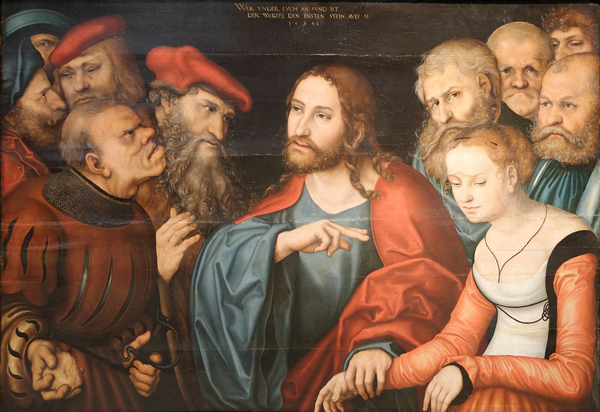
Jesus Rescues the Accused Woman [John 8:1-11] by Lucas Cranach – (Courtesy of Wikimedia Commons)

Telepathy (from Ancient Greek τῆλε (têle) ‘distant’ and πάθος/-πάθεια (páthos/-pátheia) ‘feeling’).

No man-made machine will ever match the greatest human gift. Given true humility – the under-appreciated reward of all suffering – we humans can and do communicate (spiritually, emotionally and intellectually) – with the mysterious source of all that exists – and all that has still to happen.

This is the evolutionary destiny of humankind – communion with our Source, and then – lovingly – with one another. It is a gift that comes with humility – which comes, in turn, from disaster – often the inevitable consequence of what we tend to call ‘success’.

The current triumphalist hype over computerised artificial intelligence – ‘AI’ – is certain to prove hollow. While often helpful, AI will also mislead and deceive, especially by flattery – and far too much is expected of it (especially in the role of ‘friend’).  How could any mere human artifact be the end of human history? AI is dwarfed in importance by a gift that will come to our aid in the deepest danger – to clarify our minds and take us through the most harrowing historical test – now ongoing because of techno-grandiosity.     

The Imposters – Triumph and Disaster

Historical and personal triumph is not what it seems but the threshold of disaster.  This is confirmed by scripture as well as history.

To take some historical examples: the triumph of the USA following two World Wars 1914-45 and then the Cold War with the USSR by 1989. Overreach in Vietnam 1955-75 and then in the Middle East led to the disasters of 9/11 in 2001 and then the ignominy of the Trump presidencies 2016-20 and 2024-2028 – ending the American century that had begun in 1917 with US entry into World War I. The apparent victory of US liberal democracy, touted by one commentator as ‘the end of history’ in 1990, has been revealed as fleeting by a home grown populist autocrat driven by contempt for the power-limiting principles of those who designed the US constitution.  But populism too is set for disaster. Was it truly the destiny of the USA to become a mirror image of China and Russia, misled by the myth of the ‘great leader’?   

Biblical examples of hubris ending in disaster include:

The Downfall of the Tower of Babel, built to reach to Heaven (Genesis 11:1-9)

The Downfall of Saul – first King of Israel – in paranoid hatred of David, after early victories (1 Samuel 9-31)

The Downfall of Samson after early invincibility(Judges 13-16)

The Downfall of Belshazzar king of Babylon, after triumph over Israel (Daniel 5).

As for History itself, was it inevitable that US triumph in the Cold War in 1989 – the highest point of ‘the American Century’ that began with US entry into World War I in 1917 – would be followed by the humiliation of ‘9/11’ ?  Earlier historical examples include the assassination of Julius Caesar in 44 B.C. – and the defeats of Napoleon I and Adolf Hitlers after their invasions of Russia in 1812 and 1941.  Triumphalist heroes always go too far and unite their enemies – so supreme victory is always paradoxical.

The development of nuclear weapons beginning during World War II 1939-45 was another obvious example of technological development far outstripping moral development. Why are we so much more skilled at making war than making a lasting worldwide peace?

As for the reign of Pope John Paul II – lauded for his role in the collapse of the USSR – was it inevitable that his ignoring of early warnings of the scale of clerical child sex abuse would tarnish his record once this became a global issue?

‘Power tends to corrupt,’ insisted the Catholic historian Lord Acton in 1887 ‘and absolute power corrupts absolutely.’  He was referring specifically to popes and kings who had abused power.

Jesus of Nazareth was aware of this pattern from the beginning  – the reason he resisted the temptation of not only political but institutional religious empowerment. He also knew from the scriptural record that disaster is often the necessary training for spiritual growth.

Blessed are the Poor in Spirit

“… sorrow, if welcomed with sincerity, becomes a place for conversion.”

Pope Leo XIV said this on August 13th, 2025 – at a general audience.  Commenting on the scriptural account of Jesus’ poignant last meal with the apostles he was highlighting just one of many passages in scripture that speak of disaster as the necessary threshold of better beginnings.  

Other examples include:

The throwing overboard of Jonah the prophet – by the crew of the ship on which he had attempted to flee from the mission given him by God – to warn the Ninevites of impending catastrophe. Rescued from this disaster he went on to fulfil this commission and become one of the many renowned prophets of Israel. (Jonah)

The selling of Joseph, son of Jacob, into slavery in Egypt by his jealous brothers – where Joseph won the favour of the Pharaoh and then became the saviour of his people, the Israelites, from famine. (Gen 37)

The flight of the young Moses from Egypt into the wilderness – to escape the consequences of a crime he had committed in anger.  It was there, in desolation, that Moses received the call to return to Egypt – as liberator of his people. (Exodus 2 &3)

The death of King David – seen as disaster by his son and heir Solomon, who thought himself unready to follow his father. The prayer then said by Solomon (1 Kings 3:5-14) led to the telepathic wisdom that made him renowned throughout the world of his time. That prayer is ready for repetition by anyone still today.

The blinding of Paul of Tarsus on his way to Damascus to persecute the followers of Jesus.  Convinced he had been waylaid by Jesus himself, now risen from death, Paul became an apostle to the non-Jewish world, setting a Jewish reform movement on an entirely new historical tack. (acts 9)

And Paul also used the gift that Jesus possessed to the highest degree – the gift of knowing what to say.  This included ‘death has no dominion’ (Romans 6:9) – the truest summary of the meaning of the Crucifixion and Resurrection of Jesus.

The Crisis of Technological Hubris

Exaggeration of the potential of technology will inevitably precipitate a crisis – because it postpones the necessary task of repentance – the radical rethinking that is needed to bring realisation of our greatest human need – the need to belong to something greater than ourselves. Techno hubris leads instead towards the aggrandisement of a minority – the technocrats – and the inequality and injustice that follow cannot be resolved by personality cults. The corruption of governance has always called forth the gift of prophecy – of speaking the truth fearlessly to power.

Do Not Worry About How to Speak

In all four Gospels Jesus of Nazareth – the greatest of all prophets – insists that the source of all wisdom and insight lies outside of us – but can nevertheless inspire – breathe in to – us at times of the greatest danger.

“But when you are handed over, do not worry about how to speak or what to say; what you are to say will be given to you when the time comes.” (Matt 10:19)

And when you are taken to be handed over, do not worry beforehand about what to say; no, say whatever is given to you when the time comes, because it is not you who will be speaking; it is the Holy Spirit.” (Mark 13:11)

When they take you before synagogues and magistrates and authorities, do not worry about how to defend yourselves or what to say, because when the time comes, the Holy Spirit will teach you what you should say.’”(Luke 12:11,12)

“Make up your minds not to prepare your defence, because I myself shall give you an eloquence and a wisdom that none of your opponents will be able to resist or contradict.” (Luke 21:14-15)

Jesus made clear that he too relied upon this source:

“For I did not speak on my own, but the Father who sent me commanded me what to say and how to say it.” (John 12:49,50)

For a breathtaking example of the use of this gift by Jesus, read John 8:1-11.

Attunement?

How can it happen that in a crisis we can know what to do – and can speak then as God would want us to?

First, we must already know and freely obey the Great commandments of love – of God above all and then of our neighbours – all other humans.

No hatred of any others – even of those who may hate us – can be given any room in what we feel.

This is the ‘tuning’ – the attunement – we must seek if we truly wish to serve the truth – and prayer – the honest addressing of our most serious concerns to God, as a persistent habit – is indispensable.

Note especially that ‘telepathy’ strictly means not ‘thought transference’ but a communication of feeling – our deepest emotions – over distance. To be spoken the truth must first be felt, lovingly. There is far too much evidence of the ability of honest people to speak wisely – and with inexplicable courage and insight  – to those who misuse power – for this to be dismissed as mere accident. Solomon’s request for a heart that is wise tells us where true wisdom comes from – not from our analytical brain but from our deepest emotional centre.

Experience of suffering – of powerlessness, grief and pain – is also vital – the necessary loss of the illusion of being somehow in control – for all experience of power is truly deceptive and deeply dangerous.  Only if our experience from the beginning has been one of powerlessness can we avoid the need to be stripped of power.

To suffer is essentially to experience humiliation – to realise that we are utterly powerless to save ourselves – and humiliation is almost always the necessary path to humility, the acceptance of our powerlessness as we now are.

A sudden loss of all power is the experience of desolation – but conversion is the experience then of rescue  – and the realisation in that moment, and forever afterwards – that we are held close by the One who made us.

Do not believe that there is a technological fix to the historical crisis now upon us – a consequence of the grandiosity that technological progress afflicts us with. Trust instead in the Trinity, and in your own mind and heart – and pray.

In this confidence you will then be given wisdom by the one who made you – and you will know what to do and what to say.
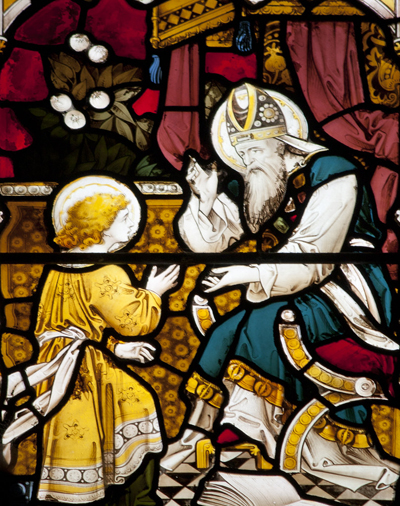
Eli tells the young Samuel that he had not woken him – that the voice Samuel had heard in the night must have come from God himself.

Here I am,’ said the young Samuel, waking up in the dark to a voice that only he could hear (1 Samuel 3:1). Are we not all being called awake in the night these times?

Views: 12

Protecting the Absolute Truth

Sean O’Conaill © Doctrine & Life, March 2001

At about the time that Dominus Iesus hit the news I heard a woman friend say, in more than a little frustration: “I say the creed every Sunday – but I still don’t really know what it means for me!”

As Dominus Iesus begins by reciting what we call the Nicene Creed as the essence of the absolute truth it defends against ‘relativism’, I find this an interesting coincidence. If the creed is the closest we can come to a summary of the absolute core of our faith, yet that summary baffles and frustrates an intelligent person with a lifetime’s experience of listening to it, we have a problem. Especially in explaining and justifying that faith to a younger generation whose attention span is determined by television.

Thinking about this further I remembered an exchange I had once had with an enthusiastic opponent of the church. “If you believe you possess the absolute truth,” this chap insisted, “you will feel yourself entitled to impose it upon me at whatever cost. Religious faith is necessarily abusive.”

The Creed?

Before protesting in the name of the many gentle and faith-filled people we know, we would do well to ponder the historical context from which this perception comes. The Nicene Creed dates from the fourth century CE– which means that it was already seven centuries old when the first Crusade led directly to the slaughter of 40,000 Muslims and Jews by Christian knights in Jerusalem in 1099 CE. Presumably some of those knights could have recited a version of this formula if asked to do so. Certainly Pope Urban II, who inspired this first crusade, could have done so.

The point is that an ability to recite the Creed seems to be entirely compatible with an ability to disembowel someone who doesn’t accept it – as indeed some of these Christians did – in the search for the gold they believed their enemies to have swallowed.

This seems to mean that we can hold staunchly to ‘the faith’ while simultaneously associating Christ – its centre – with the most frenzied violence. A question follows inevitably: of what use in the end are verbal formulae, since even the greatest of them may be deprived by their staunchest adherents of any meaning? A second question follows for the creed specifically: what absolute truth does it relate that we must hold superior to the religious wisdom of the rest of humanity? This meaning cannot be immediately conveyed by the words in which it is expressed – for otherwise no Christian could have betrayed it. And my friend could not have been frustrated by her inability to catch its meaning for her personally. We are faced with a fundamental problem of meaning – the meaning of the events the creeds relate.

Starting with this second question, it is clear that both creeds are a kind of compressed narrative relating the relationship of the Trinity to human history and to human concerns. Centrally they relate the incarnation, condemnation, execution, resurrection and ultimate elevation of Jesus of Nazareth to the role of supreme King and Judge.

Interpreting the Creed

The meaning of any narrative cannot be determined in complete isolation. For example, we cannot fully interpret Shakespeare’s Julius Caesar or Macbeth unless we become somehow involved in the problem of political ambition as posed by western culture. When Cassius suborns Brutus we will fall asleep unless somehow engaged in the problem posed: how can male self-respect survive under an emerging tyranny and personality cult? The meaning of the narrative – that is, the truth conveyed dramatically by it – is that we have here a dilemma of real, general importance – especially in eras of politically concentrated power such as that of the late sixteenth and early seventeenth centuries.

Yet we recite the creed as though its meaning were somehow contained within itself – in complete isolation from the rest of human history. And it is this that effectively deprives it of any meaning, any significance, for us. It becomes a formula that might be in Chinese for all the difference it makes to how we think about our dilemmas and fixations today. We may congratulate ourselves on not confusing the Nicene with the Apostles creed, but its meaning must be for God to interpret, as we leave it fully behind us when once this test of memory has been passed.

What happens if we do something that at first appears irreverent – juxtapose it with other well known texts and narratives – ‘stories’ – that might be comparable? The most obvious is the story of David as related in the Old Testament – as David was the model hero in the Jewish mind.

David’s story is again one of youthful recognition by God, and also youthful glory as the slayer of Goliath. This achievement sent the Philistines home straightaway, and rescued Saul, the first Jewish king, from military humiliation. But humiliation of another kind soon followed, for the women of Israel then made David supreme in their songs, to Saul’s chagrin. The result? The king whom David had rescued became his bitterest enemy – for kings were supposed to be the supreme military heroes of their people. The hero raised up by God necessarily humiliates the one who is not – and murderous violence follows, for a king cannot abide humiliation.

Further, when David finally succeeds to supreme leadership he cannot resist the temptation to possess the more beautiful wife of Uriah. What is the point of being king if someone else has precedence in this respect? Murder follows – disgracing even David. He is subject to the condemnation of the prophet Nathan. Later he witnesses his own son Absalom fall victim to envy of his own father.

What Kind of King was Jesus?

How does the story of Jesus compare? He refuses to engage in a struggle for supremacy, accepts humiliation to the extreme of a felon’s death – but is then raised up by God to everlasting life and a supreme kingship.

The pattern is simple, affecting all three of the greatest kings of Israel: worldly ‘glory’ corrupted all three; early acceptance of the antithesis of worldly glory won for Jesus an everlasting kingship. We would be wise to meditate upon this.

If it is argued that Jesus, by virtue of his divinity, was incomparable with any other historical figure, Jewish or otherwise, why should Paul need to insist that the name of Jesus ‘is above every name’ (Phil 2:9)? Why should he also insist that the crucifixion was ‘foolishness to those who were perishing’ (1 Cor 1:18). Clearly the shame attached to being a Christian in Paul’s time was by virtue of comparisons made between the humiliation of the cross and the worldly enthronement awarded to the archetypal heroes and kings of Israel. The resurrection was important not simply because it represented victory over physical death, but because it awarded a supreme and timeless elevation above all the heroes of the ancient world – the essential proclamation of Stephen for which he too was murdered.

The creeds therefore are a narrative which associate ultimate divine acclaim with the acceptance of worldly humiliation – because this acceptance avoids the pitfalls of earthly enthronement – specifically the humiliation of others and the rivalry and conflict that follows. Blessed are the poor in spirit – i.e. those who accept humiliation – for their lives are indeed laid down prostrate before the ambition of others. Jesus’ end is the logical culmination of a life lived in rejection of the climb to religious and political power – the rejection narrated in his sojourn in the desert.

The Dimension of Honour and Shame

The creeds therefore occupy a dimension of human experience that lies between glory and disgrace – as awarded by ‘the world’ as it existed in ancient times. If this dimension does not exist today, then the kingdom of God has already been achieved, and we are all truly equal in dignity and justice. If it does exist today, it is of the utmost consequence that we relate the creeds to it – for otherwise they will remain mere totems – formulae that we can recite one moment and disgrace the next.

Worldly ‘glory’ in the ancient world is ‘celebrity’ in ours: the disgraced of the ancient world are the ‘losers’ in ours. The distinction is not essentially monetary: it is the dimension between those who are known and acclaimed in local or global terms, and those who are considered of no importance, and exploited or abused. Money happens to be a common benchmark of achievement and status – as well as the means by which we require the necessities of our physical survival, and that is why it is important. In one respect history remains fixed in one place: in awarding esteem unequally. In the kingdom of God – always present where Jesus is present, and always absent to the degree the world intrudes – people are equally esteemed. In that kingdom – which can never be achieved by violence – everyone is free of everyone else’s ambition and contempt, for no-one needs to climb above others to experience self-esteem. It is therefore the only kingdom in which genuine freedom and peace applies – for no-one needs to dominate to ‘keep order’.

Joseph Campbell somewhere relates the result of a poll which showed that most black teenagers in the US – the world standard for historical success – want above all to be celebrities – ‘rich and famous’. The pop diva Madonna intends to pursue her career (we are told) until she is ‘better known than God’. In a recent interview a young ‘lager lout’ insisted that he drank himself insensible once a week to forget that he had no ‘status’. Young men in Ireland routinely commit suicide out of self-condemnation – confirming the perceived verdict of the world. Daily the media recount the doings of people who are famous merely for being well known – and few in Ireland any longer want to be priests or nurses, for these roles have lost all ‘glamour’. ‘Glamour’ too is the need of a fifteen year old English girl who wants a breast implant, encouraged by her mother – and of millions of middle-aged women throughout the west terrified of growing old.

Who Determines Our Value?

Common to all of these pathologies of modern life is the notion that we are the sum of what others think of us, that our self-esteem must be dependent upon the esteem of others.

Much violence is closely related. US teenagers carry guns – and often use them – to keep or earn ‘respect’. The Littleton massacre was planned by young men who insisted they were at the base of their school’s pyramid of esteem. David Copeland killed four people with nail bombs in England recently because ‘if no one remembers who you were, you never existed’. Alexander’s, Napoleon’s and Hitler’s problems were remarkably similar.

It is precisely because the creeds relate directly to these pathologies that they are of unique and global importance – for ‘celebrity’ on western lines is now a global phenomenon. So are the media, creating another global phenomenon – the ‘wannabe’ who can’t be, at least not on Hollywood terms. For if we are all esteem-seekers we must nearly all be esteem-poor – only those whose self-esteem is secure can actually award esteem to others.

Does Dogmatism Protect the Truth

What are the implications of all of this for ‘absolute truth’ and its protection? The elevation of verbal formulae per se as totems is clearly inadequate. The source of the ‘sin’ overcome by the crucifixion is not the experimental insights of daring theologians, but history’s pyramids of esteem of which the church itself is still, sadly, one. A church structured in this way cannot explain the creeds because it denies in practice the principle they proclaim – that Christian leadership demands humility above all else.

When asked ‘what is truth’ by his final earthly judge, Jesus offered no Catechism, no creed – simply the witness of his integrity. An ultra-verbose and remote ecclesiastical leadership bankrupts the creeds by depriving them of witness, and thus of meaning. It is time to let love – the absolute truth and the great gift of many of the church’s least educated people – lead it towards that kingdom in which all are equally esteemed. Foolishness may sometimes be spoken there, but it will do far less damage than an absolutism of the word that imposes silence while itself betraying the Word, who never silenced anyone, and who fled from celebrity rather than seek it.

Views: 10