Category Archives: Church Formation / Education

No Humility Without Humiliation

It’s a mistake to think we can programme Christian conversion.

~

We should, therefore, look to the Gospels to outline for us the journey of conversion we are required to undertake, learning little by little to make Jesus’ practices our own.”

This is just one of twenty-four references to ‘conversion’ in the Final Report of the 16th Synod on Synodality. Called to conversion by the Holy Spirit, we learn that the whole church is now to undertake a continuous conversion of relationships, of processes and of bonds.

But if ‘conversion’ is something that happens whenever we ‘undertake’ it, how come the bishops of the church were not converted to effective child protection in the church until – beginning about 1985 – victims of childhood clerical abuse – aided by secular police, lawyers, courts and media – showed us that instead bishops globally were endangering children by hiding the problem – and that this was standard procedure, mandated by the church at the highest level?

The fact that the magisterial church was converted to child protection – and then to synodality – only by this totally unexpected public relations disaster is nowhere acknowledged in this final report of the 16th Synod of 2024 – and this alone tells us that the magisterial church still has ‘ways to go’ on the conversion journey if it is to lead the rest of us convincingly.

Charged now with understanding ‘Mission’ and ‘Adult Faith Formation’, every diocese in Ireland would be wise to ask what exactly went wrong with the faith formation model we inherited.

The Great Mistake

Would we not be wise to consider the possibility that the root of the problem was a tendency to think of adult Christian faith as programmable to begin with – never questioning that schooling and seminary training, topped by the sacrament of ordination, would signify complete Christian conversion?

That these might well signify merely conversion to Catholic institutional careerism and conformity – as revealed by the disasters still ongoing – has still not been acknowledged by that same institution.

Was any great saint of the church ever converted to their mature adult faith by any formal faith formation programme, beginning in childhood? Peter, to begin with, spent three whole years with the greatest teacher ever – and was then fully converted only by the humiliating experience of his own tragic weakness when faced with the hostile crowd, and then Jesus’ forgiveness. Paul was converted – we are told – by the shocking intervention of the Lord himself, from Heaven, on the road to Damascus to root out the Christians there.

Augustine of Hippo in the late 4th century had to confront the reality of his own adult dissolution and confusion before faith could truly set in. Patrick of Ireland was converted by an entirely unplanned experience of kidnapping and slavery, while Columba of Ulster had to experience the violence caused by his own ecclesiastical ambition and rivalry with St Finnian.

Pope Francis – famously changed by adult reverses

Isn’t there a discernible pattern in all of these stories – of mature adult Christian faith arising out of unexpected humiliation rather than any early deliberate early life formation programme? Didn’t that pattern hold true for Francis of Assisi, Ignatius of Loyola, Alphonsus Liguori, Therese of Lisieux, Maximilian Kolbe, Franz Jagerstatter – and Pope Francis?

Doesn’t the entire history of the church – underlined now especially by the hierarchical disaster we are undergoing – tell us that the deepest Christian faith is arrived at only by the unplanned experience of personal life crisis and powerlessness – the necessary downfall of youthful egotism – not by any faith formation programme received in relative tranquillity?

Didn’t Pope Francis put this best: “There is no humility without humiliation!

Ordination is Not Conversion

If the church had always understood and taught this – that faith formation is always tested – and completed – ONLY by unwanted and unplannable adult setback – and that ordination and conversion are NOT the same thing – would there ever have been even a reason for secrecy over clerical child sexual abuse?

Was it not the vain belief that faith can be fully formed by school and seminary programmes that led to the mystique of clergy – the clericalism – that produced Crimen Sollicitationis in 1962 – the binding of all Catholic bishops to strict secrecy on clerical sexual abuse of minors?

This is not to argue that we do not need formation and early sacraments: both are essential if we are to interpret correctly the meaning of adult setback. The mistake is to believe that conversion is achieved if we simply ‘undertake’ it – and then complete the set course.

If there is indeed no humility without humiliation isn’t that also the explanation of the church catastrophe we are living through? Don’t we now need this insight – this warning – to be woven deeply into all of our formation programmes, to counteract the pride and naivety that can all too easily result from simply completing the programme?

Shouldn’t the church already be teaching us, explicitly, that formation and ordination are not conversion?

The Pattern of Spiritual Development

Richard Rohr OFM

For decades the contemplative Richard Rohr OFM has been teaching of the necessary experience of suffering to take us from the first half of life into the second. He defines suffering as a deep experience of complete powerlessness. Don’t we now need to understand this as humiliation, the necessary adult downfall of early egotism that cannot be programmed?

It isn’t only the church that is undergoing humiliation just now. So is the secular enlightenment, confronted by the environmental consequences of three centuries of exploitation of fossil fuel energy, as well as the real danger of nuclear self-annihilation. Hubris still counsels an onward march to ‘artificial intelligence’ but wisdom warns that pride always comes before a fall – and that the true future of humankind will be arrived at only by humiliation – and humility – first of all.

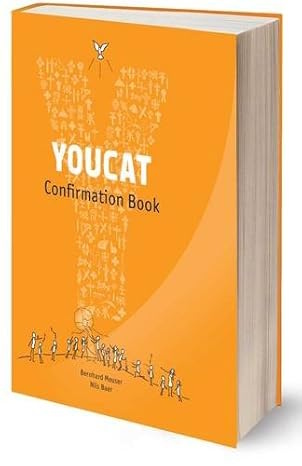
There is no escaping the disaster course that youthful pride and egotism always have in store for us humans, so how did the Catholic magisterium come to publish in 2011 a Youth Catechism – YouCat – which did not even index that word ‘pride’, giving copious examples? Will we ever hear this explained in homilies on Jesus’ question about the beam in one’s own eye that leads us to complain about the motes in the eyes of others?

Nothing could be clearer than the truth of Lord John Acton’s pithy sentence of 1887, in a letter insisting that even bishops and popes could be corrupted by power. “There is no worse heresy than that the office sanctifies the holder of it.

We are surely being trained – by the humiliation of the church – to see humbled pride as the pattern of historical human development also. Ongoing ecclesiastical and secular failures are the indispensable God-given formation and conversion course that we could never ourselves have planned.

12th July, 2026

Views: 1

YouCat, Violence and the Cross

Q. Did God will the death of his only Son?

A. The violent death of Jesus did not come about through tragic external circumstances. Jesus was “delivered up according to the definite plan and foreknowledge of God” (Acts 2:23). So that we children of sin and death might have life, the Father in heaven “made him to be sin who knew no sin” (2 Cor 5:21). The magnitude of the sacrifice that God the Father asked of his Son, corresponded to the magnitude of Christ’s obedience: “And what shall I say? ‘Father, save me from this hour’? No, for this purpose I have come to this hour” (Jn 12:27). On both sides, God’s love for men proved itself to the very end on the Cross.

[YouCat – The Youth Catechism of the Catholic Church, 2011 – Article 98]

Why should anyone be asked to believe that if God did will the death of his son for the reasons given, this death was not caused first of all by ‘tragic external circumstances’ – the sinful designs of men – that were never willed by God?

Does it not matter that through an obvious logical non sequitur a standard  Catholic catechetical source for young people could lead them to attribute the violence of the crucifixion to the will of God, rather than to human hatred?

Is it unimportant also that YouCat does not explain at this point that God’s primary project was, and still is, the utterly non-violent Kingdom of God?

As, according to the Gospel, it was the rejection of the Kingdom offered by Jesus that led to his crucifixion, why does YouCat background that rejection as a mere ‘tragic external circumstance’ and foreground the Father’s will that Jesus should die?

How can that decision help young people today to understand the prayer that Jesus gave us, for what the Father wills first of all – the coming of the Kingdom of God?

For me, in failing to insist that the killing of any person – Jesus included – is never desired, intended or arranged by God, this Catechetical approach goes to the heart of a problem well stated by Archbishop Eamon Martin in Kilkenny on October 18th, 2025. “People need the faith, they need the treasure that we have … but somehow we are finding it difficult to reach them!”1 Archbishop Eamon Martin speaking at the conclusion of the Pre-Synodal Assembly of the Irish Synodal Pathway in Kilkenny on 18 Oct 2025.
https://synod.ie/video-presentations-from-kilkenny-assembly-available-now/


Simeon, The Cross and ‘Secret Thoughts’

Simeon’s Prophecy

To begin with, that non sequitur in YouCat 98 is itself invalidated by the Gospel, taken holistically.  In Luke’s Gospel we are told that when the infant Jesus was presented in the Temple the prophet Simeon told his mother Mary that the crucifixion would happen “so that the secret thoughts of many may be laid bare” (Luke 2:34,35). Given that the ‘external circumstances’ of the crucifixion included all of those actors who sought or acquiesced in Jesus’ death – all vividly described in the Gospels  – is it likely that God never intended us to learn anything from those accounts about the motivations of those same men? 

Indeed, given the contemporary resonance of those accounts, why would it not be likely that God’s willing of the crucifixion was always intended to reveal not only the hidden thoughts of Caiaphas and Herod and Pilate, and even Judas and Peter – but whatever lies always behind aggression?

Here we encounter all of the difficulties caused by studying only the singularity of the story of Jesus as Son of God – and never the obvious fact that, read just as the story of an honest individual, it is just one of many thousands of such stories of victimisation and torture – in history and the daily news as well as scripture.


Adolescence and Violence

To take just one example, in March 2025 the UK parliament discussed a streaming TV drama called Adolescence – centred on the fictional story of a thirteen-year-old boy who, in a fit of rage, stabs to death a 14-year-old girl who has rejected and then cyber-bullied him. This plotline resonated for many as reflecting a western cultural phenomenon known as the manosphere, a widespread male rebellion against the alleged excesses of feminism. The term ‘incel’ has emerged, to describe males allegedly deprived of their ‘right’ to sexual intimacy by these alleged feminist excesses – making these put-upon males ‘involuntarily celibate’.

For UK lawmakers the context of Adolescence is not just this online phenomenon but a plague of teenage knife crime that makes the deaths of young people from uncontrolled adolescent rage a dismal staple of the daily news.

As online subcultures now have global scope, all of this is necessarily impacting on the climate in which Irish adolescents go to school – where, coincidentally, they will encounter other plotlines of sexual aggression and murder. In one of those an ancient King of Israel arranges the death in battle of the husband of a beautiful woman whom he has secretly seduced. In the very same source two elders in Babylon conspire to proposition a young wife, threatening her with an accusation that will ensure her death if she does not comply. 

Is there not a pattern in these stories, very likely the same pattern as in some shocking episodes of teen-on-teen violence in Ireland? Have we humans – males especially – an often fatal difficulty in coping with any shameful disaster – as in recent killings of wives by suspicious husbands – and even sometimes of whole families by parents facing some kind of social catastrophe?

Wasn’t King David’s murder of Uriah an archetype that echoes down the ages – the celebrity king who cannot face the shame of exposure for selfishly seducing the wife of one of his own elite soldiers?

All violence is an attempt to replace shame with self-esteem,” insists the US prison psychiatrist James Gilligan, summarising the argument of a 1996 book focused upon what he calls the ‘epidemic’ of violence in his own land2James Gilligan, Violence: Our Deadly Epidemic and Its Causes. Putnam Publishing Group 1996.


Naming the Pattern

If we focus just on the most obvious issue that arises out of all of these stories – the problem posed to King David, to that 13-year-old in Adolescence, and to anyone – by social shame we can see not only a vulnerability but an extreme danger. These ‘tragic circumstances’ all too often offer a stark choice between violence and humiliation. What name can we give to the force – or weakness – or sin – that impels so many to give tragic free rein to violence in those circumstances?

Why does scripture take us constantly to this place of violence – if not to call us to see – and name – the pattern of behaviour, and the specific human weakness, that we find there?

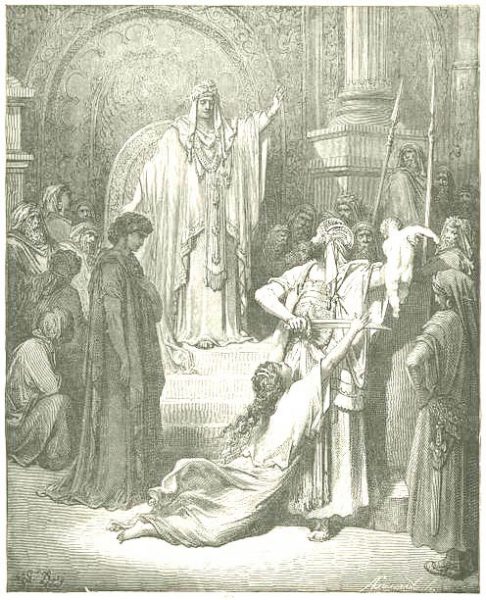
Solomon’s Judgement of two women who claim the same child – by Gustav Doré

Cain’s murder of his brother, Abel; the jealous brothers of Joseph who sell him into slavery and then deceive their father Jacob; King Saul in his bitter rivalry with the younger David; King David himself in his plotting against Uriah; Solomon’s problem of the two women who claim the same infant after one of them has overslept her own child; Jezebel the wife of King Ahab in her dispossession and murder of Naboth; those two Babylonian elders who plot against Susanna; Herod the Great’s storied resentment of the infant Jesus; the capitulation of Herod Antipas to the desire of his wife Herodias to see the head of John the Baptist on a platter; Caiaphas the High Priest who sees the elimination of Jesus as a means of avoiding a greater disorder and his own overthrow; Pilate in his sentencing of Jesus to death, despite his obvious misgivings.

Is there not an obvious pattern, a sameness, in these stories of moral failure, and then violence?

Is not the consistent root cause of that failure what is now called status anxiety – fear of loss of the respect of important others – fear of shame?3Alain de Botton, Status Anxiety, Penguin, 2004  

If so, what do we call the sin that led them in the end to capitulate to that fear – and to violence?

Does not Jesus’ disregard for his status – his freedom in calling out religious hypocrisy but lack of vindictiveness in accepting ‘blowback’ – cast the problem of his accusers and judges in the sharpest relief? Where he could accept the greatest humiliation they could not even accept the verbal charge of hypocrisy.

If his most singular virtue was indeed his humility – his willingness to tolerate humiliation, what was obviously – by contrast – their vice?


Integrity and Holiness

Is it not obvious that in asking Jesus to endure the Crucifixion the will of the Father was for Jesus to witness to the Kingdom of God of which he had preached unarmed and selflessly – right to the bitter end – and that the rejection of that kingdom by his accusers was the immediate cause of his arrest and trial?  Having preached mutual service rather than ambition, and the turning of the other cheek when insulted, how could it have been consistent for Jesus in the end to choose the only alternative to arrest and crucifixion – domination and war? 

How could he have chosen that option without matching and mirroring the pride of his enemies?

Is not aggressive violence always a choosing of pride before the kingdom of God? Is that same kingdom not exemplified by all who bear with humiliation without violence?  Are there not many such in Ireland today?

And was it not especially to take away all of these particular sins of pride – past, present and future – that Jesus died, in obedience to the Father?


Pride and Violence

Strikingly, although YouCat does list pride among the capital sins it nowhere defines or describes or instances this vice – especially as a danger to young people today. It does not even list pride in its index – while sexual behaviour and the church’s rules for that – including those for birth regulation – feature prominently.

And although YouCat does explore Jesus’s opposition to violence it does not link this to the explanation of the cross. Jesus is obedient to the Father but nowhere is it stated clearly that the Father’s willing of the Cross was a protest against prideful violence, and not a seeking of it.

And nowhere in YouCat is the psychology of violence explored – despite the fact that the Bible is probably the greatest of all literary sources on the subject.

St Anselm of Canterbury

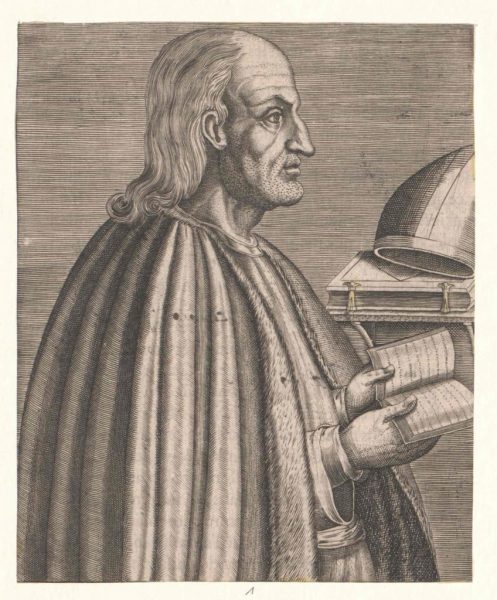
The most likely explanation for these failures is the Catholic theological inheritance of the Middle Ages. St Anselm of Canterbury could not ask himself in the 1090s if the Christian violence sanctioned first by Constantine in 312 – for example the violence of the first Crusade (1096-99) – might be tainted by pride, so instead he interpreted the Cross not as a protest against violence but primarily as the logical repayment of a debt owed to the Father by sinful humanity4St Anselm of Canterbury, Cur Deus Homo, c.1098. This unhelpful emphasis has trickled down the centuries – to the 1994 adult Catechism of the Catholic Church and to its 2011 offspring, YouCat.

The result is a resource that risks attributing the human weakness of status anxiety – and even the vice of pride – to God himself – when redemption obviously has to do with the opposite understanding – that God is, above all, both love and humility – and that he offers, through Jesus, freedom from all fear, including fear of shame.


Satan’?

The non-appearance of the name Satan in YouCat can possibly be explained  by the need to emphasise the totality of the victory of the Cross, but given the certainty of questions about Satan from young people, this is a mistake. There is an often overlooked advantage in attributing all human fault in the beginning to some source other than ourselves, and a particular advantage in attributing our status anxiety – our chronic tendency to doubt our own value as we are – to an external source, as do Genesis and the Gospels. That value becomes clear if we ask ourselves how we might counsel a young person who has been overwhelmed by an impulse towards violence, as in that TV drama Adolescence.

Is not murderous pride indeed a deeply mysterious and dark entity, a ‘force’ that can ‘get into’ us – in the most ‘tragic circumstances’? Do we truly know what we are doing then? Do we not all need to realise that this too was the Evil that was overcome in Gethsemane and on the Cross, for the forgiveness of even the worst of sins?

That the word ‘Satan’ means ‘the accuser’ – thereby naming the historical pattern of false accusation that can lead to ostracisation and lynching – is surely important for young people to know also, in a pervasive climate of online aggression and the scapegoating of immigrants.

And do we not all need to be fully conscious of what we are doing at Easter, when we renounce Satan, the author of all sinful pride?


‘Do Not Covet’?

Not for nothing does Genesis point to the ‘serpent’ as the author of all human dissatisfaction. “You are not enough as you are!” – is not this the insistent message we all mysteriously hear, in every encounter with someone who seems to have more. This too is something that young people need to understand. Our tendency towards comparison, towards feeling ashamed of what we seem to lack, and towards envy of others – especially for whatever makes those others more popular – explains the power and prestige of the 21st century ‘influencer’ – and all world conflict as well.

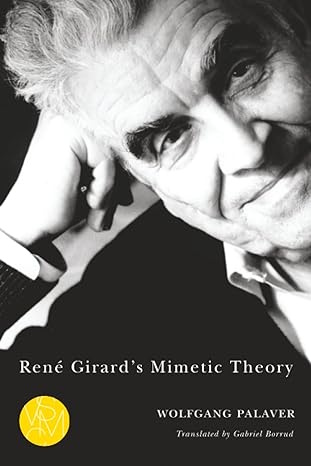
No one has explained the danger of this human frailty better than René Girard5Wolfgang Palaver, René Girard’s Mimetic Theory, Michigan State University Press 2013. If we must have whatever our envied neighbour has, what will we do if we cannot have that without violence?

To reflect on the danger of one’s own envy is to be ready to understand also why Jesus was envied by his enemies, and why he was accused. Themselves already socially eminent, those men felt keenly a lack of the supreme gifts of spiritual insight, leadership and healing they recognised in him. They felt most keenly of all his razor-sharp identification of their ‘mask-wearing’ – the pretences that too often go with mere religious performance. This was the birthplace of their conspiracy to kill him, rejecting the Kingdom they could otherwise have freely entered.

It is another peculiarity of YouCat that while it does list the warning against coveting among the ten commandments it nowhere explains the term. Don’t young people need to realise how this weakness, which we all share, is so helpful in explaining the chaos that surrounds us?

Covetousness, envy and pride – and not the will of God the Father – were together the wellspring of the violence of the Crucifixion, and lie at the root of all aggression today.

Revision

YouCat needs revision. In striving to emphasise Jesus’ obedient taking away of sin it backgrounds what led to his arrest, condemnation and execution – the rejection of the Kingdom of God by those in power. This is misguided, especially in a work intended for the young.    

  • YouCat needs to name and highlight the particular sins that motivated the enemies of Jesus – the sins that above all need to be taken away.
  • In explaining the crucifixion it needs to summarise what is now well known, especially following the insights of scholars such as René Girard and James Gilligan, about the psychological and social origins of violence.
  • As it stands, YouCat’s multiple references to sin, without specificity, reinforce the perception that Catholicism is still fixated on ‘sins of the flesh’, and its index – given especially what isn’t anywhere there – reinforces that view.
  • When it comes to ‘God’s will’ YouCat needs to say more clearly that God willed the salvific outcome of the crucifixion – the gift of Jesus’ obedience – but not the sin, the violent motives, that led to the crucifixion. The Cross reveals the human cycle of: covetousness > envy > pride > violence – but not any will of God for violence.
  • The absence of any mention of ‘Satan’ needs to be reconsidered, to justify the liturgical Easter references, to emphasise the subtlety of temptation and to name the mystery of evil.
  • Especially regrettable therefore is the marginalisation of Jesus’s central teaching on the Kingdom of God – the peaceful kingdom that can never emerge out of violence. How else can ‘God’s will’ – and the Lord’s prayer – be properly explained?      

Do not all young people these times need to know that when they ‘bite their tongues’ – instead of answering insult with insult, online or elsewhere – they too are building the kingdom of the Father – by taking up that cross?

Was it not to ensure the coming of that Kingdom that Jesus died, in obedience to the Father, to ensure that evil will not win – because covetousness, envy and pride – and violence and death and shame – now have no final dominion over anyone?

Notes

  1. Archbishop Eamon Martin speaking at the conclusion of the Pre-Synodal Assembly of the Irish Synodal Pathway in Kilkenny on 18 Oct 2025.
    https://synod.ie/video-presentations-from-kilkenny-assembly-available-now/
  2. James Gilligan, Violence: Our Deadly Epidemic and Its Causes. Putnam Publishing Group 1996
  3. Alain de Botton, Status Anxiety, Penguin, 2004 
  4. St Anselm of Canterbury, Cur Deus Homo, c.1098
  5. Wolfgang Palaver, René Girard’s Mimetic Theory, Michigan State University Press 2013

(This article was first published in The Furrow – in April 2026)

Views: 0

The Cross Is God’s Victory Over Violence

Since Vatican II the Catholic Church has been hesitating to speak clearly of the insight at its core: that the refusal of God the Father to overpower the enemies of Christ was an emphatic rejection of the use of force to build the Kingdom announced by Jesus – the Kingdom of God.

It is time to end that hesitation. The Youth Catechism published by the Church in 2011 proves that no other explanation of the Crucifixion makes sense.

YouCat’s Confusing Question and Answer

The following question and answer occur on page 65 of YouCat, The Youth Catechism of the Catholic Church.

Q 98. Did God will the death of his only Son?”

A. The violent death of Jesus did not come about through tragic external circumstances. Jesus was “delivered up according to the definite plan and foreknowledge of God” (Acts 2:23). So that we children of sin and death might have life, the Father in heaven “made him to be sin who knew no sin” (2 Cor 5:21). The magnitude of the sacrifice that God the Father asked of his Son, corresponded to the magnitude of Christ’s obedience: “And what shall I say? ‘Father, save me from this hour’? No, for this purpose I have come to this hour” (Jn 12:27). On both sides, God’s love for men proved itself to the very end on the Cross.

Is it truly obvious to anyone that God’s love for men (and, presumably, women) is proven by the statement that Jesus’s death on the cross resulted solely from God’s will.

That this inference does not come naturally – that it is counter-intuitive – is strongly suggested by all available research on Irish young people and their generally poor understanding of what happens at Easter, the church’s central sacramental event. Even so YouCat  is in use in some Irish dioceses as a reference source for faith formation – including the faith formation of adults. Question 98 (above) is not the only issue.

The Problem of Atonement.  If it was solely the will of God the Father – and not any  ‘tragic external circumstances’ – that caused the death of Jesus, then God the Father must also have predetermined the opposition to Jesus and the violence of the crucifixion. Why is it supposed that this theological perspective can close the distance between ourselves and God, when it is both scandalous and rendered obsolete by the most persuasive orthodox Catholic theology of the Cross? As Catholic teaching insists that God cannot will anyone to sin it can only be a mistake to allow any room for the inference that God the Father arranged or even condoned the violence of the persecution and crucifixion of Jesus.

The Kingdom of God is marginalized in YouCat, even though it was central to Jesus’ teaching. In Raymund Schwager’s dramatic theology of the Cross it was – and always is – the Father’s will – first of all – to build this Kingdom. Only peace reigns there – because all freely obey the two Great Commandments.  The crucifixion followed from the rejection of that kingdom by Jesus’ enemies – so this sinful rejection was a necessary cause of the predicament that obliged Jesus to choose between overpowering his enemies and death on the cross. His choice to undergo crucifixion rather than use force was not the repayment of a debt called in by God the Father for our sins but proof that the Kingdom of God cannot emerge out of violence. In Dignitatis Humanae (1965) the church rejected the use of force to spread the faith – and this was also the belief of the early church – so why is this not a sufficient explanation for Jesus’ own refusal to use force to build his Kingdom?

The Sins of Covetousness, Envy and Pride are not identified in YouCat as the sins of Jesus’s enemies that led to his arrest, false accusation and unjust execution. Nothing could be clearer than that these sins prevented them from following Jesus themselves. Yet Neither covetousness nor pride are indexed or defined or instanced in YouCat.  Envy is indexed but the explanation on page 254 confuses envy – which is directed toward a person or persons – and covetousness – a yearning for whatever the envied person possesses that the yearner cannot have without violence.

The Problem of Violence is not given central importance in YouCat even though it is central to scripture and to the dangers facing young people today. In revealing the role of covetousness, envy and pride in the opposition to Jesus the Gospel is also clearly pointing to the crucial role of those motives in all aggression.  That this revelation was intended by God is indicated by the warning to Mary given by the prophet Simeon in St Luke’s Gospel: “…and a sword will pierce your soul too — so that the secret thoughts of many may be laid bare” (Luke 2:34-35). This is not seen in YouCat.  It does see Jesus’ opposition to violence but does not link that opposition – or the will of God the Father – to Jesus’ choice of crucifixion before violence.

The name ‘Satan’ is completely missing from YouCat. In Schwager’s theology, as well as in scripture and in the Easter liturgy, Satan is identified as the generator of all aggression, via temptation, deceit and hatred.  Young people need to know the meaning of this name – ‘the Accuser’ – the dark spirit behind all breaches of the 8th commandment against ‘bearing false witness’.  They also need to know what it means to renounce Satan in the Easter liturgy – to reject all blaming of others for our own mistakes, and all unjust violence to save ourselves.

An imbalance in moral theology is inevitable if there is a dominant focus on the rules relating to sexual behaviour but no identification of the role played by covetousness, envy and pride in the genesis of injustice, crime, civil violence and war.  How can e.g. the so-called manosphere and the new Christian imperialism be countered if this is not corrected? Many young People will sense this imbalance in YouCat and tune out.

The Resurrection is not seen by YouCat as God the Father’s peaceful response to the killing of his Son – another exercise of non-violence to overpower those who use violence against the truth, through the courageous witness of believers.  That too is part of the gift of the Gospel to all faced with speaking the truth on behalf of justice. The Christian Creed is a sure passport through all hostility to the faith, all false accusation and all injustice. Believers in Jesus’ Resurrection cannot be defeated by force or the threat of death. Might, for us, will never also be Right.

Conclusion

YouCat is useful as an explainer of the church’s past mistakes – but not the answer to major questions that many young people will raise today – especially about violence and the cross and God’s part in the crucifixion of Jesus.

Dignitatis Humanae (1965) – the church’s own teaching on the principle of religious freedom – allows for an entirely different perspective – that God the Father does not and never could condone any use of violence to advance or secure the Christian truth and the Kingdom of God.

That all-important event of the death of Jesus had obviously two essential causes – the conspiracy against Jesus on the one hand, and Jesus’ obedience to God’s non-violent will on the other. God the Father did not, and could not, have willfully predetermined the first of those causes – and Christian teachers (especially) need to feel free to say that. To say that God permitted the abuse of their own freedom by Jesus’ enemies is to say something entirely different – that Christian faith can never by conveyed to anyone by the use of force.

To engage the interest of young people in the Easter story Catechists will need to see that story – and the many others in scripture on the same theme of victimisation –  as a revelation of the roots of all violence in human concern for social status. Time and again, those who choose violence in scripture do so to ‘save their faces’ – i.e. to avoid losing status. That God willed Jesus to surrender to crucifixion to reveal this connection is missing from YouCat. This textbook does not even index the greatest of all sins – pride – or name the one who personifies that sin – Satan, the Accuser.

It is time to say clearly why Jesus accepted death on the Cross: to prove by his Resurrection that violence has no future – and that God’s peaceful Kingdom will come, despite all of its enemies.

(The final two paragraphs of this article were edited for clarity on Thursday 19th February 2026.)

[To read a summary of the dramatic theology of Raymund Schwager SJ, click here.]

Views: 53

AI is Banal: Humans are Telepathic

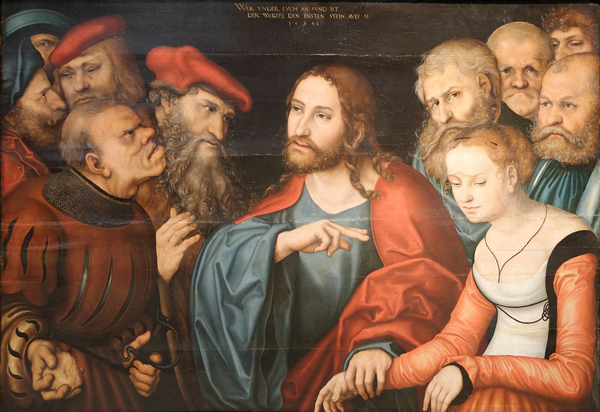
Jesus Rescues the Accused Woman [John 8:1-11] by Lucas Cranach – (Courtesy of Wikimedia Commons)

Telepathy (from Ancient Greek τῆλε (têle) ‘distant’ and πάθος/-πάθεια (páthos/-pátheia) ‘feeling’).

No man-made machine will ever match the greatest human gift. Given true humility – the under-appreciated reward of all suffering – we humans can and do communicate (spiritually, emotionally and intellectually) – with the mysterious source of all that exists – and all that has still to happen.

This is the evolutionary destiny of humankind – communion with our Source, and then – lovingly – with one another. It is a gift that comes with humility – which comes, in turn, from disaster – often the inevitable consequence of what we tend to call ‘success’.

The current triumphalist hype over computerised artificial intelligence – ‘AI’ – is certain to prove hollow. While often helpful, AI will also mislead and deceive, especially by flattery – and far too much is expected of it (especially in the role of ‘friend’).  How could any mere human artifact be the end of human history? AI is dwarfed in importance by a gift that will come to our aid in the deepest danger – to clarify our minds and take us through the most harrowing historical test – now ongoing because of techno-grandiosity.     

The Imposters – Triumph and Disaster

Historical and personal triumph is not what it seems but the threshold of disaster.  This is confirmed by scripture as well as history.

To take some historical examples: the triumph of the USA following two World Wars 1914-45 and then the Cold War with the USSR by 1989. Overreach in Vietnam 1955-75 and then in the Middle East led to the disasters of 9/11 in 2001 and then the ignominy of the Trump presidencies 2016-20 and 2024-2028 – ending the American century that had begun in 1917 with US entry into World War I. The apparent victory of US liberal democracy, touted by one commentator as ‘the end of history’ in 1990, has been revealed as fleeting by a home grown populist autocrat driven by contempt for the power-limiting principles of those who designed the US constitution.  But populism too is set for disaster. Was it truly the destiny of the USA to become a mirror image of China and Russia, misled by the myth of the ‘great leader’?   

Biblical examples of hubris ending in disaster include:

The Downfall of the Tower of Babel, built to reach to Heaven (Genesis 11:1-9)

The Downfall of Saul – first King of Israel – in paranoid hatred of David, after early victories (1 Samuel 9-31)

The Downfall of Samson after early invincibility(Judges 13-16)

The Downfall of Belshazzar king of Babylon, after triumph over Israel (Daniel 5).

As for History itself, was it inevitable that US triumph in the Cold War in 1989 – the highest point of ‘the American Century’ that began with US entry into World War I in 1917 – would be followed by the humiliation of ‘9/11’ ?  Earlier historical examples include the assassination of Julius Caesar in 44 B.C. – and the defeats of Napoleon I and Adolf Hitlers after their invasions of Russia in 1812 and 1941.  Triumphalist heroes always go too far and unite their enemies – so supreme victory is always paradoxical.

The development of nuclear weapons beginning during World War II 1939-45 was another obvious example of technological development far outstripping moral development. Why are we so much more skilled at making war than making a lasting worldwide peace?

As for the reign of Pope John Paul II – lauded for his role in the collapse of the USSR – was it inevitable that his ignoring of early warnings of the scale of clerical child sex abuse would tarnish his record once this became a global issue?

‘Power tends to corrupt,’ insisted the Catholic historian Lord Acton in 1887 ‘and absolute power corrupts absolutely.’  He was referring specifically to popes and kings who had abused power.

Jesus of Nazareth was aware of this pattern from the beginning  – the reason he resisted the temptation of not only political but institutional religious empowerment. He also knew from the scriptural record that disaster is often the necessary training for spiritual growth.

Blessed are the Poor in Spirit

“… sorrow, if welcomed with sincerity, becomes a place for conversion.”

Pope Leo XIV said this on August 13th, 2025 – at a general audience.  Commenting on the scriptural account of Jesus’ poignant last meal with the apostles he was highlighting just one of many passages in scripture that speak of disaster as the necessary threshold of better beginnings.  

Other examples include:

The throwing overboard of Jonah the prophet – by the crew of the ship on which he had attempted to flee from the mission given him by God – to warn the Ninevites of impending catastrophe. Rescued from this disaster he went on to fulfil this commission and become one of the many renowned prophets of Israel. (Jonah)

The selling of Joseph, son of Jacob, into slavery in Egypt by his jealous brothers – where Joseph won the favour of the Pharaoh and then became the saviour of his people, the Israelites, from famine. (Gen 37)

The flight of the young Moses from Egypt into the wilderness – to escape the consequences of a crime he had committed in anger.  It was there, in desolation, that Moses received the call to return to Egypt – as liberator of his people. (Exodus 2 &3)

The death of King David – seen as disaster by his son and heir Solomon, who thought himself unready to follow his father. The prayer then said by Solomon (1 Kings 3:5-14) led to the telepathic wisdom that made him renowned throughout the world of his time. That prayer is ready for repetition by anyone still today.

The blinding of Paul of Tarsus on his way to Damascus to persecute the followers of Jesus.  Convinced he had been waylaid by Jesus himself, now risen from death, Paul became an apostle to the non-Jewish world, setting a Jewish reform movement on an entirely new historical tack. (acts 9)

And Paul also used the gift that Jesus possessed to the highest degree – the gift of knowing what to say.  This included ‘death has no dominion’ (Romans 6:9) – the truest summary of the meaning of the Crucifixion and Resurrection of Jesus.

The Crisis of Technological Hubris

Exaggeration of the potential of technology will inevitably precipitate a crisis – because it postpones the necessary task of repentance – the radical rethinking that is needed to bring realisation of our greatest human need – the need to belong to something greater than ourselves. Techno hubris leads instead towards the aggrandisement of a minority – the technocrats – and the inequality and injustice that follow cannot be resolved by personality cults. The corruption of governance has always called forth the gift of prophecy – of speaking the truth fearlessly to power.

Do Not Worry About How to Speak

In all four Gospels Jesus of Nazareth – the greatest of all prophets – insists that the source of all wisdom and insight lies outside of us – but can nevertheless inspire – breathe in to – us at times of the greatest danger.

“But when you are handed over, do not worry about how to speak or what to say; what you are to say will be given to you when the time comes.” (Matt 10:19)

And when you are taken to be handed over, do not worry beforehand about what to say; no, say whatever is given to you when the time comes, because it is not you who will be speaking; it is the Holy Spirit.” (Mark 13:11)

When they take you before synagogues and magistrates and authorities, do not worry about how to defend yourselves or what to say, because when the time comes, the Holy Spirit will teach you what you should say.’”(Luke 12:11,12)

“Make up your minds not to prepare your defence, because I myself shall give you an eloquence and a wisdom that none of your opponents will be able to resist or contradict.” (Luke 21:14-15)

Jesus made clear that he too relied upon this source:

“For I did not speak on my own, but the Father who sent me commanded me what to say and how to say it.” (John 12:49,50)

For a breathtaking example of the use of this gift by Jesus, read John 8:1-11.

Attunement?

How can it happen that in a crisis we can know what to do – and can speak then as God would want us to?

First, we must already know and freely obey the Great commandments of love – of God above all and then of our neighbours – all other humans.

No hatred of any others – even of those who may hate us – can be given any room in what we feel.

This is the ‘tuning’ – the attunement – we must seek if we truly wish to serve the truth – and prayer – the honest addressing of our most serious concerns to God, as a persistent habit – is indispensable.

Note especially that ‘telepathy’ strictly means not ‘thought transference’ but a communication of feeling – our deepest emotions – over distance. To be spoken the truth must first be felt, lovingly. There is far too much evidence of the ability of honest people to speak wisely – and with inexplicable courage and insight  – to those who misuse power – for this to be dismissed as mere accident. Solomon’s request for a heart that is wise tells us where true wisdom comes from – not from our analytical brain but from our deepest emotional centre.

Experience of suffering – of powerlessness, grief and pain – is also vital – the necessary loss of the illusion of being somehow in control – for all experience of power is truly deceptive and deeply dangerous.  Only if our experience from the beginning has been one of powerlessness can we avoid the need to be stripped of power.

To suffer is essentially to experience humiliation – to realise that we are utterly powerless to save ourselves – and humiliation is almost always the necessary path to humility, the acceptance of our powerlessness as we now are.

A sudden loss of all power is the experience of desolation – but conversion is the experience then of rescue  – and the realisation in that moment, and forever afterwards – that we are held close by the One who made us.

Do not believe that there is a technological fix to the historical crisis now upon us – a consequence of the grandiosity that technological progress afflicts us with. Trust instead in the Trinity, and in your own mind and heart – and pray.

In this confidence you will then be given wisdom by the one who made you – and you will know what to do and what to say.

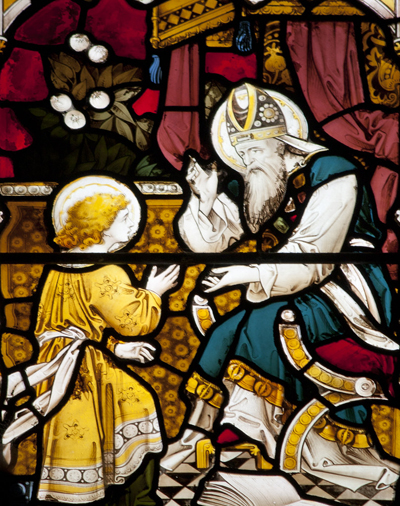
Eli tells the young Samuel that he had not woken him – that the voice Samuel had heard in the night must have come from God himself.

Here I am,’ said the young Samuel, waking up in the dark to a voice that only he could hear (1 Samuel 3:1). Are we not all being called awake in the night these times?

Views: 12

Why did Jesus of Nazareth accept Crucifixion?

  1. To rescue us from fear of the judgement of others – what Jesus calls ‘the world’ (John 16:33) – by overthrowing, without violence, the judgement of the world of his time, and all time. This fear of judgement, which comes not from God but from the Adversary, is the root of all status anxiety (fear of ‘what people think’), status seeking, inequality and violence.
  2. So that we might follow him out of love rather than fear.
  3. To teach us to forgive as He did.
  4. To reveal to us the origin of all violence in status anxiety – and the Satanic historical pattern of the accusation and scapegoating of the innocent that arises from the status anxiety of those seeking or wielding punitive power.
  5. To give us a limitless horizon – beyond mere consumption, sexual fixation and death.
  6. To offer freedom from fear to those challenged to speak the truth to abusive power, the whistle-blowers who are needed even in the church.
  7. To allow us always to review the history of the church and to lament the status anxiety that misled it too often into too close an alliance with state power (c.313 CE to c.1918 CE) under Christendom, and the many victimisations, enslavements and compromises with violence that followed – including the abuse of children by ordained clergy.
  8. To take away even those sins when we have seen them, and properly atoned.
  9. To clarify our understanding of sin as stemming from doubt of our own value, leading to the coveting of status in the positive regard of others – and all other unloving and unjust actions.
  10. To make way for the Holy Spirit, close counsellor of everyone.
  11. To bring us back to the Father our maker – and sender of Jesus our Rescuer and the Holy Spirit our counsellor.
  12. To save the world in an always New Creation – through our conversion and our witness to the Blessed Trinity of Father, Son and Holy Spirit – who accompany us always and forever.

If the earliest Christians were given new life by Jesus’ life, death and resurrection, and a vision of a new creation in a violent world now passing away, why should Christians of our time not always see this world of now as equally limited in judgement, and the Trinity as calling them always to a new and peaceful Kingdom of God, beyond all ambition and conflict? The medieval God seen by St Anselm of Canterbury as bent only on balancing the scales of an eternal justice is not the God of the apostles or of Irenaeus or the other early fathers, for whom it was God the Father who had burst their chains by sending them His Son.

Using the psychological and anthropological insights of Alain de Botton and René Girard it is time to return to the early church’s vision of Jesus of Nazareth as Christus Victor, who with the father’s help has overturned the verdict of the world, by exposing the real author of the lies that had condemned him. In the words of Gustav Aulén, interpreting Irenaeus:

“First, then, it must be emphasised that the work of atone­ment is regarded as carried through by God Himself; and this, not merely in the sense that God authorises, sanctions, and initiates the plan of salvation, but that He Himself is the effective agent in the redemptive work, from beginning to end. It is the Word of God incarnate who overcomes the tyrants which hold man in bondage; God Himself enters into the world of sin and death, that He may reconcile the world to Himself. Therefore Incarnation and Atonement stand in no sort of antithesis; rather, they belong inseparably together. It is God’s Love, the Divine agape, that removes the sentence that rested upon mankind, and creates a new relation between the human race and Himself, a relation which is altogether different from any sort of justification by legal righteousness. The whole dispensation is the work of grace.”
[Gustav Aulén, Christus Victor, 1931. S.P.C.K. edition 1965, p 34.]

Views: 3065

‘The Lightest Burden’ – Origin and Purpose

“…there is a crisis in transmission of faith … we are unsure about how to evangelise in the modern world…”

Clipped from the Irish national synodal synthesis of August 2022 this conclusion is obviously derived from the 26 diocesan synodal reports of that year – with 25 of those dioceses echoing an urgent need for adult faith formation – to address a critical problem of younger generational drift from Catholic faith practice.

My own diocese, Derry, in June 2022 reported that “There was a widespread desire among participants to learn more about their faith and many believed that adult faith formation should be available within, and between more parishes.” Further on we were told that “Plans for developing a programme of adult faith formation are already well underway in the diocese.

Despite this assurance, Derry diocese was still without an ongoing programme for adult faith development in the spring of 2024 – when I attended a two-day course in synodal leadership led by members of Ireland’s Synodal Pathway steering group, in Drumalis House, Larne (March 14,15).

Alpha & Drumalis

Embarked already from early 2024 on an invigorating Alpha course in Coleraine, I found myself challenged on the Drumalis leadership course to discern a personal synodal mission. This soon focused upon the unresolved Derry faith formation issue, with the hope of simplifying the faith formation task by starting with something familiar – the Rosary prayers – and taking a new look at those. I thought that this focus could both complement the higher-tech inter-church Alpha programme by adding a specifically Catholic dimension to it, and provide a low-tech and easily portable tool to enable family and small group use.

(The Alpha programme requires considerable investment of effort by quite a large team, as well as video projection equipment and premises that will permit the provision of refreshment.)

Concerned above all to convey the truth that Catholic Christian core beliefs are portable by any young adult I aimed at verbal compression and simplicity – and gave the pages the title ‘The Lightest Burden ‘. If Jesus insists that ‘my yoke is easy and my burden is light’ should not every effort be made at verbal simplicity and brevity – and joy – when trying to encapsulate the faith – especially for young people?

The Creed as Celebration of Jesus’ Victory over Evil

Moreover, wasn’t the original Good News simply the news of Jesus’ resurrection and therefore also of the defeat of the Accuser, Satan, the father of lies – beginning with the lies told against Jesus at his trial?

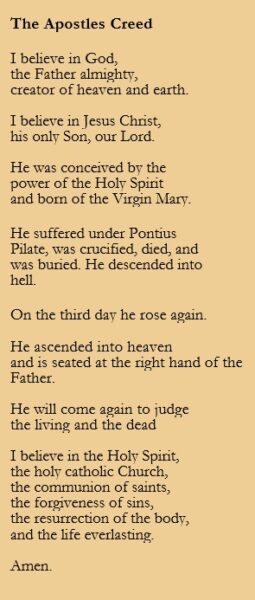
What we call the Apostles Creed was centred on this core belief in the Resurrection as the downfall of Satan the Accuser (for our sake) – and yet the history of Christendom determined that this short summary of Catholic belief was in need of vast expansion into what is often referred to as the ‘deposit of faith’. That by c. 1100 this deposit had come to include a very different emphasis – God the Father’s supposed need for satisfaction for sin – is surely the core problem of Christian evangelisation and faith formation today.

The Rosary as Celebration

The Joyful mysteries of the Rosary surely centre on the promise of Jesus’ victory over Satan – the source of all evil. The Glorious mysteries celebrate, in turn, that same victory, then the coming of the Paraclete – the defender of the oppressed – and then the enthronement of the mother of God. In between the Sorrowful mysteries take us through the suffering that won the victory.

That the Rosary is potentially always a celebratory prayer is as obvious as the fact that all too often it is recited as a penance.

‘Satisfaction’?

Why did it happen that in the second Christian millennium the Father who sent Jesus to liberate the earliest Christians – consciously – from the pall of evil that overshadowed the ancient world became instead the demanding Father who had sent Jesus to satisfy the demands of his eternal justice – i.e. primarily for his own satisfaction?

That this theological development accompanied the maximal political empowerment of the church c. 1100 CE is surely suggestive of an answer. The church had by then itself a crucial political role: the support of nominally edifying Christian European rulers – so God the Father had by then supposedly no need to liberate the world. On the other hand a very distant God who needed satisfaction for sin was very like a distant medieval king who needed his people to be obedient above all, and therefore more than a little fearful as well.

Salvation as Liberation, Now

And this is surely why there has been an argument in our own time over liberation theology. History – the history of Christendom – has seriously confused our understanding of the Creed – and made us prefer to recite it quickly and then walk away – rather than seek a new clarity that meets our current dire need for Hope.

And yet, arrested unjustly for blasphemy, in e.g. Pakistan, any Christian today could recite the Creed internally with exactly the same purpose as a Christian under the Roman emperor Diocletian – to remind herself that the Father who has raised Jesus from the dead, and the Holy Spirit who is now her advocate, will not abandon her whatever happens.

And doesn’t every young person in the world today need to know that the same stern guardians of truth are at their elbow – if the very same Accuser and liar targets them on the Internet?

That even as yet our Catholic clergy cannot emphatically tell our younger generations this is part of the legacy of Christendom – the historical empowerment of the church that has confused its theology and made Christian faith formation still problematic.

Jesus diagnosed the central human problem long ago – our tendency to look for glory from one another, rather than from God. It is our fear of one another’s scorn that leads to the telling of lies – and the need for the One who would never bow to falsehood.

The Victory of Truth is Certain

It is surely high time to stop simply reciting the Creed as a series of disconnected verbal dogmas – to restore its power as inward reassurance that Christ’s victory – and the victory of truth itself – is certain. Jewish people sometimes actually dance to the Shema Israel (‘Hear O Israel’) – the recitation of the great commandments of Israel – the commandments of love (Deut 6:4-9). Someday surely we catholic Christians must have cause to dance to the Creed?

Views: 3032

What is it to be Holy?

The Judean desert, where Jesus may have fasted and resisted temptation

What exactly is holiness? Will we know it when we see it? Is it attainable by anyone, or only by those who have made a lifelong commitment to the ‘religious’ or ‘consecrated’ life and to celibacy? How does holiness relate – if at all – to the secular virtue of integrity? 

In The Charismatic Structure of the Church: Priesthood and Religious Life at Vatican II and Beyond, Michael McGuckian SJ 1The Charismatic Structure of the Church: Priesthood and Religious Life at Vatican II and Beyond, Michael McGuckian SJ, Xlibris US, 2021provides essential historical background to the long debate on holiness in the Catholic Church and explains why complete agreement by Catholic bishops at Vatican II proved impossible to achieve. Arrested by this unexpected discovery, the author is currently busy on a sequel – not only to reinforce the call to all to ‘be perfect’ but to explain why no one should suppose that this calling is ever impossible for themselves, whatever their situation or time of life.

~

That all Catholics are called to holiness by Lumen Gentium (‘Light of Nations’ – a key document of Vatican II 1962-65) – is known at least vaguely to many of that generation and later.  However, if asked to explain clearly what holiness is and how that call can best be answered, how many could confidently respond?  If asked, perhaps scathingly, what the purpose or point of holiness could be now – by someone of a secular mindset – how many would be ‘up’ for that as well?

Necessarily the standard for holiness for all Christians was set by their founder, Jesus of Nazareth – and from the beginning those called by him to ‘follow’ and to ‘be perfect’ needed to discern how exactly to do that. Given that Jesus’s own ‘way’ was not simply one of poverty and celibacy but of exceptional risk, suffering and – in the end – catastrophe, was it even sensible to think of following all of that perfectly?  If not, what ‘way’ would be best?

The greatest virtue of The Charismatic Structure of the Church is the copious evidence it provides for the conclusion that there has never been a time in the long history of the church when Christian ‘holiness’ was a settled question, with its meaning and practice harmoniously agreed by all who sought to follow and to teach.

To marry in uncertain times, or not?

St Paul, Apostle

The difficulty of the choice between the married and celibate states was an obvious one from the start, a choice made more problematic in the first century by uncertainty over how soon Jesus would return in glory, for the Final Judgement.  St Paul’s first letter to the Corinthians clearly reveals that this was an issue in his time (e.g. 1 Cor 7).

St Monica, Mother of St Augustine of Hippo

Those who opted for perpetual virginity in those early years set an example that proved durable down the centuries, but so did those who did not.  From the latter came subsequently many Saints who then themselves became enthusiasts for virginity.  A notable example is St Augustine of Hippo in the fourth century, who strongly advocated celibacy following his conversion.  If his sainted mother Monica had been able to opt for virginity when of marriageable age, and had been so inclined, the medieval church would have been deprived unknowingly of one of its greatest luminaries.

The Monastic Model – and ‘Secular’ Clergy

Soon also there were those who decided that ‘following’ required a way of life that was separated entirely from the distracting and profligate ‘world’, and was lived within a separated community of like-minded ‘ascetics’.  This ‘coenobitic’ option was the origin of monasticism.

And yet – especially after the early fourth century legalisation of Christianity by the Emperor Constantine – the diocesan successors of the apostles needed local parish ‘presbyters’ or clerics who would not live in a separated and dedicated community but in ‘the world’ among ordinary citizens. This was the origin of the ‘secular’ or ‘diocesan’ clergy – and for the first Christian millennium many of the latter lived married rather than virginal lives.

St John Chrysostom

It followed, then, that from an early stage there could and would be strong differences of opinion on how best to follow Jesus faithfully.  Where St John Chrysostom (347-407) would insist that none of the baptised should feel unable to follow the Lord faithfully, others took Jesus’s solitary and debatable reference to ‘eunuchs’ (Matt 19: 11-12) as an injunction to lifelong celibacy.  That inevitably consigned the married state to the relative disapproval of many of those who chose that option.

We are the Holiest

The question of who was the holiest became even more unsettled with the arrival of the mendicant orders – e.g. the Franciscans and Dominicans –  in the 1200s.  Given a universal missionary mandate by the pope, they inevitably came into conflict with the hierarchical claim of diocesan bishops – that even the monks and friars should consider themselves subordinate to themselves in the scale of holiness – since ‘perfection’ was a distinctive ‘sign’ or attribute of the bishop’s apostolic office.

St Thomas Aquinas

When the Dominican friar St Thomas Aquinas disagreed and prioritised three ‘evangelical counsels’  – of poverty, chastity (i.e. celibacy) and obedience, as a ‘holocaust’ or total consecration of the person to God (1256), he was therefore setting this ascetic option up in opposition to any association of a superior holiness with the hierarchical principle – and a centuries-long disagreement between ‘secular clergy’ and ‘religious’ ensued.

That such tensions could exist between ‘regular’ clergy (those who belong to religious orders whose members are bound to a founder’s ‘rule of life’) and ‘secular’ clergy (those directly under the authority of a diocesan bishop) will astonish those lay Catholics who may fondly have supposed that no historic disharmony could ever have intruded into the equally edifying holiness of all of their ordained ministers.

Vatican II – Same Old Same Old

However, many will be even more mind-boggled to learn that this same dispute was to surface – 800 years later – at Vatican II (1962-65).

Whereas there was strong support among many bishops at the council for an emphatic statement in Lumen Gentium that regular clergy, secular clergy and laity (married or unmarried) were equally called to and capable of manifesting the same holiness (by God’s grace), a powerful lobby for the manifest superior claim of the evangelical counsels was eventually successful in frustrating that aim.

Two consequences followed: not only does Chapter 5 of Lumen Gentium (‘The Universal Call to Holiness in the Church’) lack the insistence that all of the baptised are called to the same holiness, but immediately following, in a separate chapter entitled ‘Religious‘, there is an assertion of the superior claim to holiness for the following of the evangelical counsels, including celibacy.

As a result, while Chapter 5 of Lumen Gentium stresses that all in the church are called to holiness, Chapter 6 of the same document insists that the evangelical counsels of poverty, celibacy and obedience ‘are based upon the words and examples of the Lord’.  Furthermore, this ‘religious state whose purpose is to free its members from earthly cares, more fully manifests to all believers the presence of heavenly goods already possessed here below’. (44)

That marriage and the nurturing and the safeguarding of children are thereby declared ‘earthly cares’ that are inherently less capable of ‘manifesting the presence of heavenly goods’ (i.e. of holiness) will baffle lay Catholics today,  especially in light of the revelations of the last three decades. Global church events since the 1980s have raised the most serious questions over any claim to a moral or spiritual superiority for any chosen ‘state of life’ or hierarchical office – up to and including the office of pope.  Jesus’s most solemn adjurations re the protection of the innocence of children have had a new and shocking impact. Pope Francis’s frank and welcome admission that he too is a sinner – and has also made mistakes in handling clerical child abuse – provides a postscript to Lumen Gentium Chapter 6 that underlines its shortcomings.

An Unsatisfactory Confusion

Michael McGuckian therefore concludes that at present the church’s formal teaching position on holiness is ambivalent and unsatisfactory. Whereas all are called to holiness by Lumen Gentium, this is not clearly – in this important document – the same call to the same holiness. By implication the holiness to which lay people can aspire can only be, at best, the avoidance of serious sin. Those bishops who insisted on the insertion of Chapter 6 into Lumen Gentium could not agree to the use of the phrase ‘same holiness’ in any part of the document other than article 39 – where it clearly refers only to those who observe the evangelical counsels. Subsequent magisterial treatments of holiness – e.g.  Vita Consecrata by St John Paul II (1996) – have not resolved this problem either, in his view.

Can we avoid the conclusion that the recruitment crisis for the celibate priesthood is still preventing a full and unequivocal acknowledgement of the equal call to, and potential for, holiness of the unordained and non-celibate majority of the baptised people of God?

In light of this situation, and the hovering threat of the Vatican watchdog, the Congregation for the Doctrine of the Faith, what Catholic evangelist today would take on to preach on the meaning of holiness for lay people – especially in the wake of the revelation that, apparently, integrity – so emphatically modelled for us by Jesus – was never a consideration or an issue at Vatican II when holiness was under discussion?

Are Christian holiness and Christian love the same?

In a subsequent recorded interview Michael McGuckian promotes a persuasive solution to the problem of defining holiness:  we should look to the Great Commandments of love of God above all, and of neighbour as oneself – the Shema Israel still recited and sung  by observant Jews today and reiterated by Jesus (eg. In Matt 22: 37-40). We should look also to Jesus’s own new commandment in John 13:34 – to love one another as he has loved us. These, Michael insists, are a non-postponeable and binding call to be perfect in love – a call that can be heard and obeyed at any stage of life – or in any state of life – by any of the baptised without distinction.

On discovering that St Augustine and St Thomas Aquinas had agreed that these Great Commandments of Jesus and the Torah were not real commandments  – because they demand an unattainable perfection – Michael McGuckian was unimpressed and unconvinced, and is now bent on explaining why.

If anyone else has ever wondered why, in the wake of Vatican II, no Irish bishop ever convened his people of God to consider together how they could ‘consecrate the world to God’ (Lumen Gentium 34), this book will greatly help to explain all that. It has not only addressed most of my own questions on holiness, but given me an invaluable historical overview of the issue. My only slight complaint relates to its title. While ‘The Charismatic Structure of the Church’ may signal the book’s content clearly to experts on church structure, something like ‘Holiness? A History of Disagreement’ would have made it a ‘must read’ for me as soon as it was launched in April 2021.

It must surely be seen also now that the citation out of context of Matthew 19:12  in the Catechism of the Catholic Church (Article 1579) – the sole reference by Jesus to celibacy in the Gospels – is a scandalous leaning on the scales in the cause of making celibacy a necessary condition of ordination.  That Gospel context was a discussion of Jesus’s teaching against easy divorce, a teaching that was obviously also ‘for the sake of the kingdom of God’. In light of the known contemporary Jewish expectation that religious men would marry, by far the most sensible inference to be drawn from Jesus’s subsequent reference to eunuchs is that celibacy could also serve the kingdom, not that it would better or would best serve the kingdom.

Holiness and Integrity

This needs especially to be said at this time, in light of the global revelation that priestly celibacy can as readily be a matter of mere appearances as of fact. Here Jesus’s denunciations of hypocrisy – of seeking to be regarded as holy – have not yet received the attention they deserve (e.g. Matt 6:1-6). That unknown multitudes of innocent children and vulnerable adults have suffered lifelong agonies as a consequence is now indisputable, and the cost of centuries of concealment of this reality has not yet been fully acknowledged and redressed.

Fr Michael McGuckian SJ

We can therefore anticipate that in his next book – on that same subject – Michael McGuckian will be citing Jesus’s story of the equal reward given to the latecomers in the vineyard to question any claim that any office or chosen state of life can entitle anyone to a superior expectation of ‘the treasure hidden in the field’.  We can also hope that the critical importance of integrity – the conformity of behaviour with what is vowed and professed, or is implied by any church role or office – will be emphasised.

The ancient belief that personal holiness must come automatically with the conferring of any particular office, even that of bishop, must surely also be finally rejected. Here Lord Acton’s comment on the danger of attributing holiness to a person solely on account of that person’s role or official status has too long been ignored: ‘There is no worse heresy than that the office sanctifies the holder of it.’2Lord Acton, letter to Mandell Creighton, 1887

Can disobedience be holy?

Also – in regard to the virtue of obedience – that a good conscience can oblige anyone to disobey a religious superior needs now also to be emphasised – since everyone understands now that unholy obedience was also a major factor in the global tide of recent scandal. Why, for so long, was Jesus’s courage in challenging the Jewish religious hierarchies of his own time never seen as a distinctive mark of his sanctity? That a fetish for lace-laden clerical attire could be preferred as a sign of holiness in the long era of clericalist illusion will forever be remembered.

St Mary McKillop
1842-1909
The Holiness of the Family

The canonisation of the Australian Saint Mary McKillop in 2010 is conclusive proof of the need to qualify the elevation of obedience as a requirement for holiness. Personally pilloried for her calling out of a clerical abuser in Australia, the cross of excommunication she was obliged to carry in 1871 is a dire warning against a pernicious religious authoritarianism – the expectation of deference in all circumstances by a religious superior.

Finally, the ongoing promotion of the ‘domestic church’ to an indispensable role in the faith formation of adults as well as children has its own logic.  If parents and grandparents are truly to have the primary responsibility for encouraging and guiding the faith development of their children, must this not be recognised as a call to a sacred role and a holy task, modelled on the example of the Holy Family?  That we should still be so distant from a full and unequivocal recognition of the same call to every baptised person – to respond sincerely to the greatest commandments of integrity and love in whatever space we currently occupy – speaks loudly for the timeliness of this book.

Notes

  1. The Charismatic Structure of the Church: Priesthood and Religious Life at Vatican II and Beyond, Michael McGuckian SJ, Xlibris US, 2021
  2. Lord Acton, letter to Mandell Creighton, 1887

Sean O’Conaill, 19th August 2021 
(This article first appeared on the website of the Association of Catholics in Ireland)

Views: 2798

The Creed is for Whistle-Blowers, not Dogmatists

Tony Flannery – who in 2020 asked: ‘What is the point of the Creeds?’

By far the worst thing ever to happen to the Christian Creeds of the early centuries was that they became tools of persecution by hunters of Christian heretics in the Middle Ages. (c. 476 CE – c. 1453)

The second-worst thing that happened to them was their use by the compilers of Catechisms – for the persecution of many generations of Christian children who could be beaten in school for failing to remember what the Catechism said.

With one self-defeating arm of the bureaucracy of  the Catholic Church in pursuit of heretics until recently, it is no wonder that cancelled Catholic priest Tony Flannery should ask in 2020 What is the point of the Creeds?’1‘From the Outside: Rethinking Church Doctrine’, Tony Flannery, Red Stripe Press, 2020

The shortest answer to this question goes as follows:

First, the Apostles Creed is a summary of the faith the led the earliest church through its worst persecutions. It was a passport through persecution, NOT a licence for persecution – and should never have been used for that purpose.

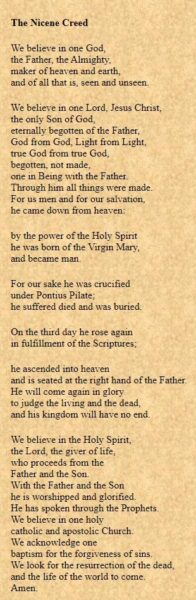
Second, the Nicene Creed is a mere ‘tweaking’ of the Apostles Creed, to insist upon the equality of all three persons of the Trinity – Father, Son and Holy Spirit. It should never have been used as a tool of religious oppression either.

The ‘Credo’ of Jesus of Nazareth

The English word ‘Creed’ derives from the Latin word ‘Credo’ which means ‘I believe’. Every firm believer is in need of a summary of what they believe – and Jesus’ own people, the Jews had that.  Called the ‘Shema‘ (the Hebrew word for ‘Listen’ or ‘Hear’) it was recalled by Jesus when he was asked, in Mark’s Gospel, what was the greatest of the commandments.

He replied as follows:

‘This is the first: Listen, Israel, the Lord our God is the one, only Lord, and you must love the Lord your God with all your heart, with all your soul, with all your mind and with all your strength. The second is this: You must love your neighbour as yourself. There is no commandment greater than these.’  (Mark 12: 29-31)

This was a direct quotation from one of the oldest of the Hebrew scriptures, or ‘Old Testament’, the Book of Deuteronomy. ‘“Hear O Israel: Yahweh our God is the one, the only Yahweh. You must love Yahweh your God with all your heart, with all your soul, with all your strength.” (Deut 6: 4,5)

Because the Apostles Creed affirms Jesus as ‘Son of God’ it follows that what Jesus believed is also binding for Christians, so we believe ourselves also bound by the ‘Shema’ as the basis of all other laws, including the Ten Commandments given to Moses.

As explained by Luke Timothy Johnson in ‘The Creed’, the Apostles Creed grew naturally out of the Shema – to explain to Jews and Gentiles why Jesus’s story was central to Christian belief.

Jesus’s Crucifixion was a Beginning, not an End

The earliest Christians believed firmly in Jesus’s survival of crucifixion. What is impossible for many who are attracted to Jesus’s teachings today – the belief that he had been somehow raised from the death proscribed by a Roman governor of Palestine, in about 30 CE — was the firm belief of those who compiled the four Gospels and the Creed.

It is obvious also why that belief was affirmed in the Creed. It reassured the Christian believer that his or her own life would endure beyond physical death –  as a follower of this man who had not been simply obliterated by the worst persecution that the greatest empire of the time could devise.

It is the most grotesque irony of the history of Christianity that the Creed should itself in later centuries have become an instrument of persecution. To call Jesus ‘Lord’ was, for the first Christians, to deny supreme authority to Caesar – and therefore to endanger oneself, as Jesus himself had done by criticising the religious elite of his own time.

On the third day he rose again.

This insistence on the truth of the Resurrection of Jesus is the central and pivotal statement in the Creed – explaining everything that comes before that in the Creed, and everything that followed. For the purpose of the Creed was to assure the believer that in following Jesus, as a mere human, the same victory over death could be achieved. The power claimed by Rome, or any other authority, was thereby ‘relativised’ – reduced to mere appearances and ‘passing away’ – temporary.

That Jesus was human also – as vulnerable to suffering and death as the rest of us – was therefore also to be believed.  For otherwise how could survival of death be possible for merely human believers in Jesus?

But Jesus was also ‘Son of God’ and himself divine.  So therefore, somehow, he had been ‘conceived’ by – or ‘brought into being by’ – the Holy Spirit of God.

How are we to understand today the insistence upon the ‘virginity’ of Mary, the mother of Jesus?  Some scripture scholars tell us that the original meaning of the word did not originally imply that Jesus’s conception happened without sexual intercourse, but that probably cannot be proven,  What is certain is that the process by which Jesus was ‘conceived’ or ‘begotten’ by God was for early Christians a secondary matter – dependent upon the conviction that through Jesus we come to know God – and to know that God is love.

The Creed Summarises the Gospels

Because the Creed was in later centuries used to justify the persecution of Christian ‘rebels’ or ‘heretics’,  it is sometimes alleged that it was the product of the Constantinian Roman Empire – and therefore NOT what Christians originally believed.  This can be disproven simply by comparing it with what is asserted in the four Gospels.

To take just the Gospel of Matthew to start with, it is clear that the belief that God is a ‘Trinity’ of three persons was central to the early church.  Completed probably by as early as 100 CE Matthew’s Gospel gives us in Chapter 28 Jesus’s final instruction to his followers, AFTER the crucifixion:

Go, therefore, make disciples of all nations; baptise them in the name of the Father and of the Son and of the Holy Spirit. (Matt 28: 19)

Although the Nicene Creed did emerge in the wake of Constantine’s decision to approve Christian belief it is also clearly a mirror of the earlier wording.  What is distinctive about it is simply its insistence upon Jesus as an equal member of the Trinity – something questioned by Arianism, a ‘heresy’ of the time that made Jesus clearly inferior in status to the Father.

In that one Gospel, therefore, completed centuries before Constantine, we find the central beliefs of the Creed – that Jesus had survived crucifixion and taught that God was a Trinity.

The Nicene Creed also affirms the equality of the Trinity

Can Unarmed Love Conquer Death?

Think about it just for ten seconds. Other than the complete faith of the founders of the Christian tradition that Jesus had risen, what else can explain why there ever was a Christian tradition?

That faith has proved far stronger than the Roman imperial conviction that crucifixion would do what the Romans were certain it would do – scrub anyone who suffered it completely from historical memory. 

All merely human empires are built on a premise of permanence via the shaming of others, and almost everyone knows now what a ghastly and doomed premise that is.

The Creed simply means that it is unarmed truth in the face of armed power that drives history forward. Through their courage and their vulnerability, it is the speakers of unarmed truth to power who are best remembered and best loved.

Because, somehow, truth-tellers, whistleblowers, are definitely not ever, in any circumstances – truly alone.

Views: 2604

‘Holy Sacrifice?’

Without question our Irish Catholic chapels – especially the smallest – are both holy sanctuaries and places of sacrifice.

That is, they are places set aside for the sacrifice of time… for contemplation… of a life given totally to others, in love.  The life of Jesus.

And places for the Holy Sacrifice of the Mass, the celebration of that greatest gift ever given, and of the gifts that we now make of ourselves. 

And places of celebration of the other lives that loved him, the life of Mary, the Mother of God, of Joseph. The lives and holy deaths of the Saints.

Places of proof that such a life is not only possible but historically verified in all the lives that have followed, in hopeful imitation, over so many generations.

Of that life that did not ever end, that rose from death, that is alive still in the memory and bodies of local people who came with their own sacrifices of penitence and self-giving.

Places for the shedding of whatever in us that is unholy, selfish, dark – and therefore places of penitence, forgiveness, light, generosity, restoration and renewal.

For the shedding of tears over centuries and centuries – wrenched by miseries that only the angels have total record of …

And places of sacred bonding in marriage, of sacred parting in the mystery of death.

And places of Baptism, First Communion, Confirmation, weekly Mass – the rites of passage from womb to tomb – in stubborn hope of the eternity that children trust to in their own innocence and wisdom.

These churches memorialise those who designed and built them with love – with that letting go of the little wealth they could donate, for the sake of that dream of eternity.

What could it mean that such places – and especially the smallest – could now be under threat of closure, of the dying of the sanctuary lamp, of shuttering, of decay or transfer to another usage?

What better source of meaning has replaced the Creed that built these Holy Places?

None whatever! Merely the novelty of meaninglessness, the entrancement of a commerce that glories in novelty, illusion, unreality – the endless screenings of stories of superheroism that deny human vulnerability and the facticity of death.

If our chapels are in danger of closure, that is not because the Trinity are absent but simply because our pastors are temporarily without passion for the Creed and the Gospel , and cannot convey to us why Holy Sacrifice is still the only trustable path to the future.

We must now therefore make holy sacrifice of a different kind – in our own vigilance and prayer and study – to keep these places safe and holy for a better time, for a renewed Eucharistic ministry. 

For, built in confidence in the power of Holy Sacrifice, they belong to the future, to the Omega, the Christ, the One who is coming – who must find them clean and warm, lit and welcoming.

They must not be sacrificed to the dark, grasping, confused and baffled present.

Views: 42

Catholic Education and the Future: Insights from René Girard


By Sean O’Conaill and Eugene McElhinney

 “I have integrity, but when winning gets in the way of integrity, integrity goes out the window.” 1Lord Sugar launches his search for a new Young Apprentice; BBC Media Centre, 2011

Attributed in 2011 to a seventeen-year-old contestant in the UK televised reality show, Young Apprentice, this comment resists easy assessment.  Read lightly it can certainly be understood as the facetious acting-out of an ebullient stage persona, by a shrewd young aspirant to stardom who knew there can be media advantage in appearing outrageous.

However, this student’s own Catholic school might have worried that such enthusiastic public support for amorality could be taken more seriously by the school’s competitors, and even by prospecting parents, in a widely diverse and still conflicted society (Northern Ireland).

As former teaching colleagues in that very school we two add our own misgivings over that to other concerning data – to raise the question of the impact of even the best catechetical formation in Catholic schools when set against the background of a fragmented student experience that is far wider and weightier, and is now seriously impacted by international media of all kinds.  This wider formative experience – of the school as well as the student – increasingly pressurises schools to succeed in terms of ‘winning’ something – and cannot be subject to the intent of the church’s General Directory for Catechesis.

Under the heading of ‘other concerning data’ we mention especially the implications of the two-to-one rejection of the church’s official position on the Irish referendum to repeal the 8th amendment to the constitution (forbidding abortion) on May 25th, 2018 – with younger generations proving even more solidly in favour of repeal.  This reinforces the implications of the widely observed departure of school-going teenagers from religious observance In Ireland, and the testimony given by Archbishop Diarmuid Martin of Dublin to Pope Benedict XVI in 2006: “I can go to parishes on a Sunday where I find no person in the congregations between the ages of 16 and 36. None at all.”2Irish bishops in Rome for talks with Pope, Irish Times,  Mon, Oct 16, 2006

We hear also from our own contacts that, increasingly, young people will freely declare that they find such observance too often ‘boring’ and ‘irrelevant to our lives’.  This is supported by sample research reported by the US Barna Group in 2017 – suggesting that less than one in three young people in the Republic feel they have a clear grasp of core Christian beliefs, while one in four may be facing a crisis of faith.  The same report found that, increasingly, young people are dissatisfied with what they see as the passive/conformist faith of older generations, while one in four now claims to have no religious belief at all.3Finding Faith in Ireland: the Shifting Spiritual Landscape of Teens and Young Adults in the Republic of Ireland, Barna Group, 2017.  (This report is based on both qualitative and quantitative study of 790 subjects in the 14-25 age range, and interviews with 63 youth workers.)

 It seems that increasingly while our Catholic schools are considered successful in teaching a ‘life-readying’ curriculum they are less effective in their efforts to pass on an observant and committed Catholic faith.

Reasons for Optimism

Nevertheless, despite these worrying indicators, we two are far from pessimistic about the long-term dominance of that wider disintegrated student experience, heavily influenced as it is by post-modernist scepticism.  Furthermore, we foresee a new adult faith formation initiative that will change the mind of any adult who thinks that their school formation taught them all they could wish to know about the meaning of the Gospel.

The reason for our optimism is simple. We see unmistakably, in an international context, the beginnings of a deeply rational response to secular scepticism, a response of extraordinary explanatory and educative power – and we see that gentle ‘force’ growing.  Heavily influenced as they are just now by the scepticism and relativism of the secular Enlightenment – currently cresting in Ireland – the ‘human sciences’ are nevertheless, in all cases, under growing international challenge from an academic movement inspired by a single powerful 20th century insight – an insight that strongly supports orthodox Christian belief.4See e.g. the website of the international Colloquium on Violence and Religion

This is the observation that we humans do not in fact behave as though ‘naturally’ free to choose our own separate destinies, as the secular Enlightenment tends to teach.  We tend instead to be trapped unconsciously in replication of one another’s desires, because – at least to begin with – we literally do not know what we want.  

This insight first surfaced in the late 1950s in the context of literary criticism.  René Girard, a French émigré academic in the US state of Indiana, came to notice a pattern in the heroes of five ‘classic’ European novels.  In every case the desires of those heroes had been absorbed from a model, an historical or contemporaneous ‘other’, to whom those heroes were drawn by the supposed superiority of that model.

For example, Flaubert’s provincial heroine Madame Bovary is absorbed by the supposedly far more glamorous lives of the Parisian society women in her magazines, and seeks to model herself upon them, with fateful consequences.

In all such cases these heroes find freedom from mimetic ‘followership’ only in the tragic realisation that this captivity has prevented them from being their fearful yet real ‘selves’.  In the case of Cervantes’ Don Quixote, this character has literally been ‘out of his own mind’ in wanting to be the mythical medieval knight, Amadis of Gaul.5Deceit, Desire, and the Novel: Self and Other in Literary Structure by René Girard, The Johns Hopkins University Press, 1966

In writing these stories these great novelists (Cervantes, Stendhal, Flaubert, Dostoyevsky, Proust) had also been admitting their own vanity in once supposing themselves heroic authors of their own destiny.  Furthermore, in the case of Stendhal (The Red and the Black), the hero of this novel, Julien Sorel, points to an earlier historical sequence in the case of his own heroic model, Napoleon I.  Through his many admiring biographers this same non-fictional Emperor of the French was well known in Stendhal’s time to have modelled his own career on classical European military predecessors, Alexander of Macedon and Julius Caesar of ancient Rome.

For Girard this raised the question of what other literary sources might point to this phenomenon of ‘mimetic desire’ (desire acquired unconsciously from someone else) – as a dominant influence on human behaviour, and therefore as a pervasive ‘human problem’ of which the secular Enlightenment seemed oblivious.  Already possessing a doctorate in medieval history Girard had no doubt that this phenomenon was important not only in literature, but in ‘real life’- as a potent source of real violence.

Pursuing this interest Girard branched into anthropology and philosophy, and came to identify mimetic desire as a dominant theme of world literature – with special attention to the Judeo-Christian texts that we know as the Bible.  As the imitation of the desires of a living person is obviously dangerous (e.g. in the case of the desire of Paris, prince of Troy, for Helen, the wife of King Menelaus of Sparta; or the desires of both Argentina and Great Britain to control the Falkland Islands in 1982; or the desire of Joseph’s brothers for his coloured coat) how had humanity coped with and survived this problem from earliest times?

Girard theorised then that the answer to this question was to be found in archaic religion, centred on the practice of ritual sacrifice, and that the thrice uttered climactic warning in the Decalogue of Moses – not to ‘covet anything your neighbour has’ – was also an attempt to limit the potential damage of doing just that, by simple prohibition.

The singular importance of the Bible lies, according to Girard, in its exposure of the typical culmination of the dangerous enmities caused by mimetic rivalry. Wanting what another also wants will lead easily to the striking of a blow if the object of desire cannot be shared, and the first blow struck in anger can then quickly escalate to a civil crisis – especially in any society without adequate policing and judicial structures. The human tendency to evade responsibility for our own mistakes has led always naturally to the unjust blaming of someone else. Those with most to lose from any such escalating crisis will therefore tend to sink their own differences in the accusation of, and then the killing or expulsion of, an isolated individual – the ‘scapegoat’. This has the effect of ‘saving the community’ by releasing the tensions of the crisis at minimum cost, bringing a temporary peace.

Again and again this phenomenon is revealed in scripture to Girard’s lens: in the throwing overboard of Jonah by the entire crew of the ship on which he has attempted to flee; in the story of Joseph and his brothers;  in the many psalms which tell of a single victim surrounded by enemies; in the story of Job who is deserted and accused even by his own friends; in the ‘suffering servant’ of Isaiah; in the Gospel case of the intended stoning of the ‘woman taken in adultery’ (John 7:53–8:11).  Finally, the meaning of what is happening is explicitly identified by Caiaphas in his justification of the killing of Jesus: “you fail to see that it is to your advantage that one man should die for the people, rather than that the whole nation should perish”.  (John 11: 49)

Ritualised sacrifice in archaic religion was, according to Girard, the half-conscious commemoration of this spontaneous scapegoating event.  In that ritual the essential all-against-one character of the event was faithfully replicated, as was the shedding of the victim’s blood.6For Girard, Christian sacrifice as ritualised in the Mass is radically different – because no deflection of violence onto another is involved. Jesus as the model for the sacrificing priest was also victim, the ‘giver of himself’.  In exposing the injustice of the scapegoating process Jesus also provided a ritualised bloodless alternative to the sacrifices of the ancient world and now bids all believers to imitate this self-giving.  It is implicit that no further victimisation should follow.

As Girard is being taken seriously by Catholic theologians, as well as by academics in the entire range of the human sciences – from philosophy and history to anthropology, literature, economics, political science and even psychiatry – it is surely appropriate for all who have an interest in Catholic education – and in the wider influences that now also impact on all students – to pay attention.  As Girard’s insight can explain also such enveloping phenomena as celebrity mania, high-street fashion, body-fixation, life-style modelling, Internet trolling and needless ‘consumerism’- and the unpredictable violence and many other developing crises of our era – it should, we believe, be in discussion in Catholic schools wherever curriculum development is taken seriously.

In our particular experience of that one school (which ended for O’Conaill in 1996 and for McElhinney in 2003) it was not on the school’s pressurised timetable to discuss the impact of that changing wider society, or even of what was being learned in ‘secular’ subjects, on ‘faith development’.  To our regret we never met as colleagues to discuss the possible impact of the curriculum of the History department, or of classes on ‘current affairs’ (O’Conaill) on the programme of ‘RE’ (McElhinney), or vice versa.  Looking back we find this an important reflection on the current situation – especially because O’Conaill had a particular interest in the 18th century Enlightenment and McElhinney was simultaneously fighting that very challenge.  We know that now we would want to be discussing ‘mimetic desire’ as an obviously overlapping concern – and with other humanities departments too, as a ‘whole school’ concern.

The History Teacher

Back then O’Conaill was typically explaining things in history class as follows:  England’s ‘1066’ as ‘the rivalry of kings’; Henry II’s invasion of Ireland in 1171 as ‘acquisitive imperialism’; Northern Ireland conflict as having to do with ‘clashing nationalisms’; the Cold War as ‘a struggle for global hegemony’.  Now he would probably view Islamic Jihadism in western cities as ‘frustrated envy of the West’. To see and say that all of these might simply also be ‘wanting what your neighbour wants’ would have appeared far too naïve back then.

O’Conaill was noticing also the apparent reciprocal need that each of the far extremes in NI politics had to ‘feed off’ the enmity and opposition of the other, their clashing yet ‘symbiotic’ relationship.  He notices now, and regrets, this need for an elaborate vocabulary for the pervasive phenomenon of rivalry, the inevitable ‘locked in’ nature of each of two ‘neighbours’ wanting always what the other wants – sovereign power.  He would also probably be utilising some of the resources of the nearby Corrymeela community, in Ballycastle, where Protestant teachers seeking peace have been drawing also from the Girardian well.7See e.g. The Far Side of Revenge: Reflections on the Northern Ireland Peace Process, Duncan Morrow, 2016

Now also O’Conaill would wish to know what biblical stories are currently being covered in RE classes at all age levels, and could be confident that he shared a basic common explanatory vocabulary with RE.  He would be interested in knowing when the story of Tom Sawyer’s painting of his Aunt Polly’s fence was likely to be discussed in English class, or if Pip’s desire to become ‘a gentleman’ in order to court Estella, Miss Havisham’s niece, might be ‘coming up’ in Dickens’ ‘Great Expectations’ – or with what year group Shakespeare’s ‘Julius Caesar’ might occur, the dictator of Rome who was ‘neighbour’ to and envied target of ‘lean and hungry’ Cassius.

The RE Teacher

As a young teacher of Religious Education back in the late 1960s, McElhinney’s received wisdom was that the subject had to move away from the apologetics that had marked his own experience of it as a schoolboy. Two influential educationalists, Fr. Josef Jungmann, an Austrian Jesuit, and, later, Johannes Hoffinger, were now advocating what they called the kerygmatic approach. To them scripture was the kerygma, or herald of the good news of salvation. The emphasis switched from dogma to scripture, liturgy, doctrine and service.

Although this was seen as an improvement on the old creed-based approach it was still removed from pupils’ experiences of living out their faith.  As we moved into the seventies and eighties an Irish Catechetical Programme was drawn up for use in Key Stage 3 which was more pupil-centred.  It drew on pupils’ experiences and used modern interactive methods such as song, story, discussion and  illustration to engage pupils with content that touched on scripture, sacrament and liturgy.

An important element of this programme was the complementary support that was hoped for from the home and the parish. In retrospect these programmes were attempting to present to young teenagers the history of salvation and the church’s mediation of that salvation through sacrament in a way that was supposedly suited to their physical, cognitive, moral, social and religious development. In Key Stages 4 and 5, less overtly catechetical programmes dominated with greater emphasis being place on the academic aspect of Religious Education which meant that it had to pursue a more academic and open approach to religious belief.

While religious education teachers were ‘delivering’ this prescribed curriculum within the confines of their classrooms, societal changes were exerting powerful influences outside the school that were to challenge, and in some cases undermine, the liturgical and moral beliefs and practices of the religious education being followed. The growing inter-connectedness of the world, revealing greater success in the natural sciences, coupled with largely unregulated and unchallenged dissemination of information and ideologies, left religious education teachers having to counter an avalanche of counter cultures.  There was no coming of age in this new dispensation and little coming to terms with these pervasive pressures. In a generation we had moved from a village culture to a global one and we were not prepared for the latter. As Barry warned us back in the mid nineties the “.. influence of culture escapes our consciousness”. We need to find “… how any of us encultured human beings can become free enough from our culture to be believers”.8Barry, W., U.S. Culture and Contemporary Spirituality. Review for Religious 54, 6-21 (1995)

From 1985 McElhinney became aware of the seminal influence of the counter culture led by René Girard (1923-2015). This French academic, who began his academic life as a teacher of medieval history, had from about 1961 begun to expose in a series of books and articles, elements of culture that were to advance our understanding of our anthropology.  This helped many catechists to find that way sought by Barry to free ourselves from our culture in order to proclaim the Good News in a new way.

Girard’s mimetic theory engendered McElhinney’s own conversion from seeing the world and social relations in a binary perspective to understanding it in a triangular one. That is, in addition to an object of desire and the person who desires it, there is also, pervasively, a third party – the admired person, the model whose desire has been mimicked.  The Romantic Lie of the 18th century Enlightenment had led the academic world to believe that we have autonomy in decision making and that we are autonomous in our social relations and in our sense of self. Girard’s exposure of this lie has revealed to us, as Michael Kirwan expresses it: “The self is, rather, an ‘unstable, constantly changing, evanescent structure’ brought into existence by desire.”9Kirwan, M., Discovering Girard, Darton, Longman and Todd (2004), (p. 19)

McElhinney was led by the realisation of this dynamic to a deeper understanding of teacher/pupil relationships; pupil/pupil relationships; culture/pupil relationships and the Judeo/Christian history of salvation. Put simply, he now believes that the role of the Religious Education teacher in a Catholic school has to take account of Girard’s mimetic theory because at the core of the relationship between the teacher (catechist) and the pupil must be the quality of authenticity.

McElhinney was introduced to this idea in 1985 by a Dutch Academic, Roel Kaptein, who explained it like this. The teacher wishes the pupils to learn and the pupils wish to learn because it is the wish of the teacher. This is mimesis. At those times when the pupils do not wish to learn we teachers tend to wonder what is wrong with them. That is the wrong question to ask. We should ask, what is wrong with us? If the teacher is not wishing (in heart and mind) for the pupils to learn, the pupils who are in mimesis with the teacher will recognise this and cease to wish to learn. We need to understand that mimesis is not just something of the head, and teaching is not just something of the head either.  It is related to the totality of one’s being. Otherwise the teacher is just using words. When this is the case the pupils also will only deal in words – because again they will be in mimesis with the teacher.

A particular problem in this regard for the Catechist is that because schools place such a high priority on academic success and hence provide a breeding ground for rivalry and envious desire, pupils need to be reminded that while there is a corresponding academic aspiration for success in religious education, there is also a requirement to follow the prospectus set out in the Sermon on the Mount. The religious education teacher has to witness to this in his/her classroom and in his/her life.

The matter of autonomy exercises the minds of teenagers greatly. They feel constrained by some of the sexual moral teaching of the Church, which they think outdated and repressive. The prohibitions of the Decalogue seem to them like a blunt instrument to subdue and spoil their enjoyment of life. In pre-Girardian days McElhinney’s teaching on moral issues upheld the orthodox approach of the Catholic Catechism. Today he would approach moral issues via an exploration of the mimetic dynamic of the reciprocity of desire and self-identity.  He would be challenging students to look for mimetic models of their own desires – and to note the impact of Christian servant-leader models, beginning with Jesus, upon the behaviour of countless ‘followers’ throughout history.

This is not to say that sexual fidelity and discipline should cease to be a deep concern of a Christian school. In fact mimetic theory also exposes the role so often played by mimetic competition in the destabilising of sexual relationships. Girard was very supportive of the Augustinian understanding of ‘disordered desire’ (concupiscence) as a very real phenomenon that continues to cause intense harm and suffering.  His insight helps us to see this disorder more clearly in the all-too-frequent ‘conspiring’ of sexual desire and mimetic desire to form a dangerous ‘perfect storm’ – a theme that Shakespeare and so many others have so often visited.

Other disciplines

As authenticity and enthusiasm will be present in all effective teaching – and all of the ‘humanities’ must now address a gathering human crisis – both of us see enormous potential in Girardian insight for the entire second level school curriculum.

With respect to the environmental crisis, we wonder how Geography and Economics explain the frustrating reluctance to grapple with that now, in arguably the world’s most advanced ‘consumer society’?  How do these academic subjects explain desire for the latest iteration of the iPhone when it is not truly needed – or why Rory McIlroy finds it so profitable to wear the Nike logo – the ‘swoosh’ – on his golf cap?  For those who now study politics, how is the rivalry of one-time close political colleagues – so often a potent source of political instability – to be explained?

When it comes to the personal welfare of pupils we wonder if the phenomenon of online ‘trolling’ is being addressed as an inevitable effect of mimetic rivalry and of competition for the ultimate put-down – rivalry that must happen when an audience of unknown size is known to be observing a ‘discussion’. What of the dynamic of the bullying of a pupil, if it happens within the school itself, or via mobile devices outside?  Are some pupils perhaps dangerously over-needy of attention, and resentful that others may be getting more of that?  What explains the pull of ‘social media’ and ‘fear of missing out’ if not the discontent that arises from the apparently greater success and happiness of others – with ‘viral popularity’ and ‘celebrity’ as the supposed last horizons of human achievement? Is it time for all schools to challenge – head on – the deepest mistake of contemporary culture – the belief that our value as individual human beings (and the worth of any school) is determined by social accolade?

We two also remember vividly the occasion of the loss by one pupil of a treasured role in a school musical – a part then given to her close friend, whose friendship she then rejected bitterly.  Is it now understood why that rupture happened (and could happen again to others) and why the pupil concerned felt that she could not remain at the school?

Under the heading of pupil welfare and the possibility of ‘self-harming’ (in the context of media obsessed with body image), who in the school might read with benefit Girard’s essay on the coincidence of the very first clinical diagnoses of anorexia with the rise of 19th century printed popular media – media that obsessed over the body rivalries of highly connected ‘beauties’, including ‘Sissi’, Empress Elizabeth of Austria (1854-98) and Eugénie, Empress of France (1853-71)?10Eating Disorders and Mimetic Desire, René Girard, Contagion 3, 1996

As for that 2011 declaration by a bright pupil of our own old school – that, when it came to winning, his integrity would go ‘out the window’ – was that not simply a case of ‘catching’ the very same desire that motivated his rivals (‘mimetic contagion’)?  And might the young author of the comment now be able to see that he was explaining, albeit unconsciously, the cause of so many failures of integrity, in all eras?

Teachers of the ‘hard’ sciences should surely be interested also, as they will be aware of the accusation that modern science has destabilised the human ecosystem.  Nor can they be indifferent to instances of the corruption of scientific research through intense mimetic competition for global fame.  Is the misuse of science – for example in the nuclear arms race – not in itself a scientific conundrum that needs our deepest attention?  Girardian insight into ‘coveting’ makes RE a compelling component of a ‘rounded education’ for students who specialise in science or computing – or in languages.

Conclusion

The gravitational pull of the problem of sexuality has for too long unbalanced Christian moralism and education.  Jesus’s own celibacy has facilitated an idealisation of that specific life-choice as the sine-qua-non of sanctity, while his obvious rejection of the status-seeking and power-seeking cultural models of the ancient world has received far less attention.

Girard’s insight teaches us to look more closely at those temptations of Jesus that are recorded in the synoptic Gospels, at the start of his ministry.  None of these was sexual. All three were invitations to aspire to power and status – of the sorcerers of the ancient world; of the Jewish Temple hierarchy; and of the kings and emperors of Jesus’s own era (e.g. Matt 4: 1-11).  That is, they were appeals to mimetic desire. Jesus himself claimed to have overcome not the problem of sexual attraction but the problem of ‘the world’, i.e. of an enveloping culture that provided so many dangerous models of desire to distract him from his mission of bringing all humans back to the spirituality of Psalm 23, i.e. to intimate relationship with ‘the Father’.

That ‘sinlessness’ has therefore centrally to do with overcoming covetousness – understood as mimetic desire – becomes clear in the Girardian lens.  That Jesus’s supreme achievement lay in this rather than in his celibacy could not be so easily seen or preached in the long centuries of Christendom.  Beginning with Emperor Constantine in the fourth century, the church was always then beholden to state power won by force, from whose military elites it so often drew its own hierarchs.  How, for example, could the Christian bishops of Constantine’s time see covetousness (i.e. mimetic rivalry) in the decisive battle of the Milvian Bridge in 312, when Constantine’s supporters were insisting that he had been told by Jesus’s God to defeat Maxentius under the sign of the cross?  The self-censorship – even connivance – that fell then upon Christian hierarchs in their relations with their own state actors and social elites was to persist into our own time – with deeply scandalous consequences.

Now that the tide of Christendom is fast receding, René Girard’s insight has revealed that phenomenon of covetousness as the dominant human and political problem of both past and present – and given an entirely fresh relevance to the Creeds.  We feel confident that this insight is set to redirect the Enlightenment, to revolutionise the way that future generations will interpret the world, and to undo what Pope Benedict XVI has termed ‘the dictatorship of relativism’.

Knowing well that Enlightenment scepticism derives huge leverage from the argument that all claims to an ‘objective truth’ are necessarily oppressive, we know also that there can be no question of imposing Girardian mimetic theory on any school, or any teacher.  As the bishops of Vatican II observed in 1965, “Truth can impose itself on the mind of man only in virtue of its own truth, which wins over the mind with both gentleness and power.”.11Vatican II – Declaration on Religious Freedom, 1, 1965

 In the end it can only be the explanatory power of Girard’s insight, and its verification in the personal experience and observation of any teacher, that will together ‘win over’ anyone.  We two can only ask:  Do we humans tend to imitate those we see as ‘modelling’ our own ideal lives? Is there danger or futility in many of the ‘models’ or ‘icons’ that our pupils encounter these times?  And has evangelical secularism yet explained, or even squarely addressed, its own Utopian failures?

If Girard is correct about the dominance of unconscious imitation in the desires that drive us, it follows that we humans simply cannot do without models—that we are necessarily ‘mimetic’. We can all surely agree that Christianity, and Catholicism – in contrast to ‘media culture’ – have many real models of integrity.  These in turn have sought to model their own lives on the one who denied himself the kingdoms of the earth – and who called us to attend to those whom the world miscalls ‘losers’.  To be ‘counter-cultural’ is to continue that tradition. If we are to learn how to do that now, decisively, in our own time we surely need to observe closely how the wider culture ‘works’, and come to our own conclusions on why this happens.

For us two retired Catholic teachers the central Christian belief in the human importance of a historical model of complete integrity is now amply supported by rational mimetic theory.12René Girard’s Mimetic Theory by Wolfgang Palaver (Michigan State University Press),2013

Challenging philosophical relativism on its own ground, this seems to us the best explanation so far of the failure of the secular Enlightenment to take us to liberty, equality and fraternity in over two centuries of trying. We are confident that a thoroughly integrated and coherent Christian second-level curriculum – and a thoroughly reorganised adult faith formation system – will someday bear witness to this.

Notes

  1. Lord Sugar launches his search for a new Young Apprentice; BBC Media Centre, 2011
  2. Irish bishops in Rome for talks with Pope, Irish Times,  Mon, Oct 16, 2006
  3. Finding Faith in Ireland: the Shifting Spiritual Landscape of Teens and Young Adults in the Republic of Ireland, Barna Group, 2017.  (This report is based on both qualitative and quantitative study of 790 subjects in the 14-25 age range, and interviews with 63 youth workers.)
  4. See e.g. the website of the international Colloquium on Violence and Religion
  5. Deceit, Desire, and the Novel: Self and Other in Literary Structure by René Girard, The Johns Hopkins University Press, 1966
  6. For Girard, Christian sacrifice as ritualised in the Mass is radically different – because no deflection of violence onto another is involved. Jesus as the model for the sacrificing priest was also victim, the ‘giver of himself’.  In exposing the injustice of the scapegoating process Jesus also provided a ritualised bloodless alternative to the sacrifices of the ancient world and now bids all believers to imitate this self-giving.  It is implicit that no further victimisation should follow.
  7. See e.g. The Far Side of Revenge: Reflections on the Northern Ireland Peace Process, Duncan Morrow, 2016
  8. Barry, W., U.S. Culture and Contemporary Spirituality. Review for Religious 54, 6-21 (1995)
  9. Kirwan, M., Discovering Girard, Darton, Longman and Todd (2004), (p. 19)
  10. Eating Disorders and Mimetic Desire, René Girard, Contagion 3, 1996
  11. Vatican II – Declaration on Religious Freedom, 1, 1965
  12. René Girard’s Mimetic Theory by Wolfgang Palaver (Michigan State University Press),2013

Views: 2743